2012 Antarctic ozone hole second smallest in 20 years
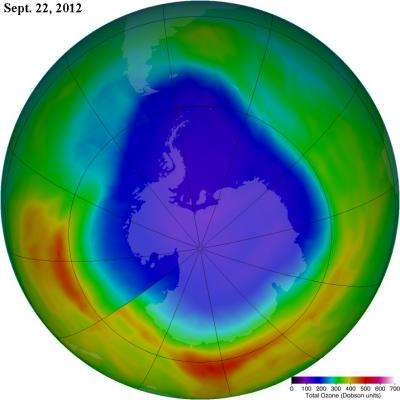
The average area covered by the Antarctic ozone hole this year was the second smallest in the last 20 years, according to data from NASA and National Oceanic and Atmospheric Administration (NOAA) satellites. Scientists attribute the change to warmer temperatures in the Antarctic lower stratosphere.
The ozone hole reached its maximum size Sept. 22, covering 8.2 million square miles (21.2 million square kilometers), or the area of the United States, Canada and Mexico combined. The average size of the 2012 ozone hole was 6.9 million square miles (17.9 million square kilometers). The Sept. 6, 2000 ozone hole was the largest on record at 11.5 million square miles (29.9 million square kilometers).
"The ozone hole mainly is caused by chlorine from human-produced chemicals, and these chlorine levels are still sizable in the Antarctic stratosphere," said NASA atmospheric scientist Paul Newman of NASA's Goddard Space Flight Center in Greenbelt, Md. "Natural fluctuations in weather patterns resulted in warmer stratospheric temperatures this year. These temperatures led to a smaller ozone hole."
The ozone layer acts as Earth's natural shield against ultraviolet radiation, which can cause skin cancer. The ozone hole phenomenon began making a yearly appearance in the early 1980s. The Antarctic ozone layer likely will not return to its early 1980s state until about 2065, Newman said. The lengthy recovery is because of the long lifetimes of ozone-depleting substances in the atmosphere. Overall atmospheric ozone no longer is declining as concentrations of ozone-depleting substances decrease. The decrease is the result of an international agreement regulating the production of certain chemicals.
This year also showed a change in the concentration of ozone over the Antarctic. The minimum value of total ozone in the ozone hole was the second highest level in two decades. Total ozone, measured in Dobson units (DU), reached 124 DU on Oct. 1. NOAA ground-based measurements at the South Pole recorded 136 DU on Oct. 5. When the ozone hole is not present, total ozone typically ranges from 240-500 DU.
This is the first year growth of the ozone hole has been observed by an ozone-monitoring instrument on the Suomi National Polar-orbiting Partnership (NPP) satellite. The instrument, called the Ozone Mapping Profiler Suite (OMPS), is based on previous instruments, such as the Total Ozone Mapping Spectrometer (TOMS) and the Solar Backscatter Ultraviolet instrument (SBUV/2), which have flown on multiple satellites. OMPS continues a satellite record dating back to the early 1970s.
In addition to observing the annual formation and extent of the ozone hole, scientists hope OMPS will help them better understand ozone destruction in the middle and upper stratosphere with its Nadir Profiler. Ozone variations in the lower stratosphere will be measured with its Limb Profiler.
"OMPS Limb looks sideways, and it can measure ozone as a function of height," said Pawan K. Bhartia, a NASA atmospheric physicist and OMPS Limb instrument lead. "This OMPS instrument allows us to more closely see the vertical development of Antarctic ozone depletion in the lower stratosphere where the ozone hole occurs."
Provided by NASA's Goddard Space Flight Center


