'Trojan horse' effect may explain jellyfish blooms
Sep 07, 2012
'Trojan horse' effect may explain jellyfish blooms

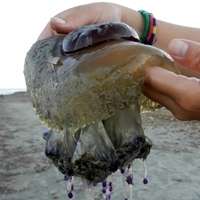
(Phys.org)—Man-made structures such as harbours, tourist facilities, oil rigs and aquaculture farms provide ideal sanctuaries for jellyfish polyps to flourish and may explain an apparent increase in jellyfish blooms in many coastal waters around the world.

That's the conclusion of a new study published by a group of international researchers, including lead author Winthrop Professor Carlos Duarte, Director of the Oceans Institute at The University of Western Australia.

Their paper Is sprawl a cause of blooms? appeared this week in the journal Frontiers in Ecology and the Environment.

Professor Duarte said most theories that seek to explain increased jellyfish blooms focus on jellyfish at their more mature swimming stage and factors such as a lack of predators or competitors due to overfishing.

But the new study examined the tiny polyp phase of jellyfish and found they congregate in millions on the underside of man-made structures.

"We call this new proposition the '' hypothesis," Professor Duarte said.

"The proliferation of such as harbours, shipping facilities and aquaculture structures provides a habitat for jellyfish polyps and may be an important driver in explaining the global increase in jellyfish blooms."

Professor Duarte said jellyfish larvae typically settle on a hard surface and grow into polyps as part of a colony.  The polyps are generally inconspicuous because they are very small - usually only a millimetre or so in length.

The study examined polyps growing on a variety of man-made structures around the world - including in Japan, Britain, Spain and Slovenia - and looked under docks, piers, pontoons and , and on the underside of oysters attached to piers.

"Jellyfish existed on the underside of such artificial structures at densities of more than 10,000 individuals per square metre, and sometimes up to 100,000 per square metre," Professor Duarte said.

Research was also conducted in Chesapeake Bay in the US and in a laboratory with a Mediterranean jellyfish species to examine how larvae settled on oyster shells, flagstones and 16 other surfaces, including bricks, ropes, cans, wood, concrete and plastic.

Explore further: Climate change may have little impact on tropical lizards

add to favorites email to friend print save as pdf

Related Stories

Dutch zoo breeds own jellyfish

Sep 29, 2007

Marine biologists at a Dutch zoo say they have succeeded in the difficult task of breeding jellyfish in captivity.

Jellyfish on the rise: study

Apr 18, 2012

Jellyfish are increasing in the majority of the world's coastal ecosystems, according to the first global study of jellyfish abundance by University of British Columbia researchers.

Spanish resort in jellyfish alert

May 27, 2011

Authorities in the Spanish tourist hotspot of Benidorm said Friday they have reopened its beaches to tourists after removing more than a tonne of dangerous jellyfish.

Jellyfish joyride a threat to the oceans

Jun 08, 2009

Early action could be crucial to addressing the problem of major increases in jellyfish numbers, which appears to be the result of human activities.

Recommended for you

Climate change may have little impact on tropical lizards

May 17, 2013

A new Dartmouth College study finds human-caused climate change may have little impact on many species of tropical lizards, contradicting a host of recent studies that predict their widespread extinction in a rapidly warming ...

Wetlands: value to locals matters most

May 17, 2013

A new way of valuing ecosystem services, incorporating the local perspective, is the driving force behind a project assessing aquatic ecosystems in highland areas of Asia

Symbolic saviour of an endangered species

May 16, 2013

In 2006 Berlin Zoo saw the birth of their first polar bear cub in 33 years. A retired circus polar bear gave birth to two cubs at the zoo. One of them died soon after, but Knut survived. At only a month old he became the ...

User comments : 0

More news stories

Front-row seats to climate change

By day, insects provide the white noise of the South, but the night belongs to the amphibians. In a typical year, the Southern air hangs heavy from the humidity and the sounds of wildlife.

Galaxy's Ring of Fire

Johnny Cash may have preferred this galaxy's burning ring of fire to the one he sang about falling into in his popular song. The "starburst ring" seen at center in red and yellow hues is not the product of ...

New colonoscope provides ground-breaking view of colon

A ground-breaking advance in colonoscopy technology signals the future of colorectal care, according to research presented today at Digestive Disease Week(DDW). Additional research focuses on optimizing the minimal withdrawal ...