September 4, 2012 report
Team reports brain-controlled ambulation in robotic leg test
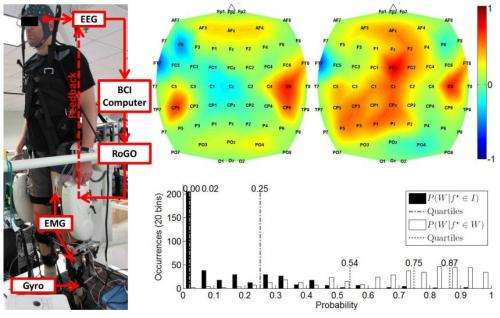
(Phys.org)—Spinal cord injury victims may be able to look forward to life beyond a wheelchair via a robotic leg prosthesis controlled by brain waves. Individuals with paraplegia due to spinal cord injury who are wheelchair-bound face serious health problems, or in medical terminology, comorbidities, such as metabolic derangement, heart disease, osteoporosis, and pressure ulcers. New research efforts are being directed toward restoring brain-controlled ambulation for those who suffer from spinal cord injuries.
An Do, MD, at the Long Beach Veterans Affairs Medical Center in California and colleagues at the University of California Irvine, have succeeded in connecting a mind-computer interface to a robotic leg. "This finding represents the first successful demonstration of a BCI-controlled lower extremity prosthesis for independent ambulation," say the researchers. They built and tested a prosthetic lower limb that can be controlled in real time by EEG (electroencephalogram) signals fed into a computer.
Their work is presented in a paper, "Brain-Computer Interface Controlled Robotic Gait Orthosis: A Case Report," by An H. Do, Po T. Wang, Christine E. King, Sophia N. Chun, and Zoran Nenadic.
In previous work, they developed a way of using EEG signals to control the walking motion of an avatar in a virtual environment.
Their tests involved recording EEG data from an able-bodied subject alternating between walking and standing. The data was used to generate an EEG prediction model for online BCI operation. A commercial robotic gait orthosis system was interfaced with the BCI computer to allow for computerized control. In an online test, the subject was tasked to ambulate using the system when prompted by computerized cues. The researchers assessed how the system performed with cross-correlation analysis, latency, and omission and false alarm rates.
The latter, "false alarm rates" was of great concern as unintended steps in realtime could be deadly for a user, such as trying to cross the street or waiting for a train. They found that the system did not result in any unintended steps, or "false alarms."
Still in its early stage, their research needs to turn another corner as they must test the system on a subject with spinal cord injury.
At this stage, their efforts are regarded as important first steps toward future devices to restore walking to individuals with paraplegia due to spinal cord injury, and possibly for rehabilitation of those with incomplete motor injuries. Do and colleagues state that "these results provide preliminary evidence that restoring brain-controlled ambulation may be possible. However, future work is necessary to test this system in individuals with paraplegia due to SCI."
Their project was funded by the Long Beach Veterans Affairs Southern California Institute for Research and Education (SCIRE) Small Projects Grant, and the Long Beach Veterans Affairs Advanced Research Fellowship Grant.
More information: Brain-Computer Interface Controlled Robotic Gait Orthosis: A Case Report, arXiv:1208.5024v1 [cs.HC], arxiv.org/abs/1208.5024v1
Abstract
An able-bodied subject used walking motor imagery to accurately operate a non-invasive brain-computer interface (BCI) controlled robotic gait orthosis. This finding represents the first successful demonstration of a BCI-controlled lower extremity prosthesis for independent ambulation, with significant implications for restoring ambulation to individuals with spinal cord injury paraplegia.
© 2012 Phys.org


