Tadpole shrimp a new pest of rice in the midsouthern United States
Sep 28, 2012
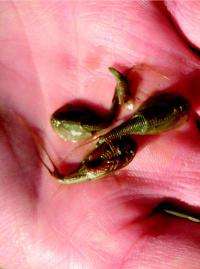
This shows tadpole shrimp adults. Credit: © 2012 Entomological Society of America

Tadpole shrimp are pests of rice production systems in California and have recently been found impacting Missouri and Arkansas rice fields. The shrimp feed on rice seedlings and uproot them during foraging, and their foraging behavior causes water to become muddy, which reduces light penetration to submerged seedlings and delays the development of the rice plant.

In "Review of a New Pest of Rice, Tadpole Shrimp (Notostraca: Triopsidae), in the Midsouthern United States and a Winter Scouting Method of Rice Fields for Preplanting Detection," a new open-access article appearing in the Journal of , the authors provide information on the life cycle of tadpole shrimp, describe a new method for scouting for tadpole shrimp in rice fields, and provide scouting results and management implications.

In the article, the authors discuss the tadpole shrimp's biology, life cycle, and distribution range, as well as options for controlling it. The authors also note that after the rice seedling stage, tadpole shrimp can be beneficial because they also eat weed seedlings and small insects.

Explore further: Hydro power frenzy 'threatens Carpathian mountains'

More information: The full article is available for free at tinyurl.com/cjqwd4r

add to favorites email to friend print save as pdf

Related Stories

Water-stingy agriculture reduces arsenic in rice markedly

Jul 28, 2008

A new farming method first developed to conserve precious irrigation water may have the added benefit of producing rice containing much less arsenic than rice grown using traditional rice-farming methods, researchers in the ...

New shrimp species found in Queensland waterhole

Apr 07, 2011

(PhysOrg.com) -- With the torrential downpours in Queensland this year roadside waterholes are abundant, and it is in one of these waterholes that professor Brian Timms has discovered a new species of shrimp. ...

Recommended for you

Unkempt, weedy land unintentionally boosts wildlife

4 hours ago

Parts of the farm landscape that look overgrown and 'scruffy' are more important in supporting wildlife than they first appear, according to new research published today in Ecology Letters.

Why we need to put the fish back into fisheries

11 hours ago

Overfishing has reduced fish populations and biodiversity across much of the world's oceans. In response, fisheries are increasingly reliant on a handful of highly valuable shellfish. However, new research by the University ...

User comments : 0

More news stories

Mapping a route to stem cell therapies

Monash University researchers are shedding light on the complex processes that underpin the creation and differentiation of stem cells, bringing closer the promise of 'miracle' therapies.

Tiny, implantable coil promises hope for emphysema patients

A small, easily implantable device called the Lung Volume Reduction Coil (LVRC) may play a key role in the treatment of two types of emphysema, according to a study conducted in Europe. Results of the study indicate the beneficial ...