Reduction in fish harvesting necessary to protect healthy stocks in future
(Phys.org)—Fish populations around the world could soon be full of slow growing, unproductive 'couch potatoes' if the current levels of intensive fishing continue, according to Deakin University research.
Associate Professor Peter Biro, an ecologist with Deakin's School of Life and Environmental Sciences, has found that faster growing fish, regardless of their size, fall prey to fishing nets at twice the rate of slower growing fish.
According to Associate Professor Biro, this could force a human-driven evolutionary shift to populations of slow growing, unproductive, couch potatoes of the fish world which would have serious implications for fish stocks.
"Fisheries are already declining around the world. If we continue to harvest the fast growing fish, we run the risk of forcing an evolutionary shift toward slow growing fish, as fish growth rates are significantly underpinned by genetics. Slow growing fish are less fertile, so ultimately fish supplies will decline," he explained.
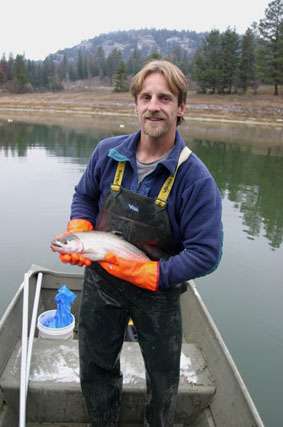
For the study, Associate Professor Biro simulated a wild fishery by stocking four small lakes in British Columbia, Canada, each with equal numbers of slow, medium and fast-growing wild origin rainbow trout. The lakes previously contained no fish, experienced no predation by birds, were remote and were closed to fishing. After allowing the fish to grow between spring and autumn, each lake was harvested using gillnets, a common commercial fishing method whereby nets are cast over large areas to catch the largest possible number of fish.
"Even though I sampled all areas of the lake randomly, and the gear was not selective on size, fast-growers were harvested at twice the rate of slower-growing individuals," he said.
"I believe the faster growers are harvested at a higher rate because they are more active, aggressive and bold. Essentially to maintain a fast growth trajectory individuals have got to get out and about, they can't be fast growing if they sit underneath a log cowering. The fast-growers are likely swimming around more, searching out food to a greater extent than slow-growers and are therefore more likely to encounter the fishing nets.
"What I was also interested to find was that the catch rates were not affected by the size of the fish, for example, the fast growing small fish were caught at twice the rate of the slow growing small fish."
Associate Professor Biro said that what is happening in the fishing industry is a stark contrast to the approach with agriculture.
"In agriculture selective breeding is used to increase production; more eggs, more meat, more milk for example. By contrast, the way we harvest in wild fisheries we achieve the exact opposite; we are pushing the fish populations to be slower growing and therefore less productive," he said.
Associate Professor Biro is not optimistic that commercial, or even recreational, fishers will curb their behaviour in light of his research results.
"I believe that reducing harvest rates is, unfortunately, the only way to preserve fish stocks into the future, which is not something that those making a living from fishing are likely to agree to. I am not optimistic that this information is going to be used before the problem comes to a head, and we are left with few fish that are slow growing, and have little capacity to bounce back from overexploitation."
Provided by Deakin University


