MAVEN: Next Mars mission enters final phase before launch
Sep 11, 2012
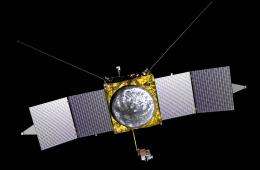
Artist's Concept of MAVEN. Credit: NASA

NASA's Mars Atmosphere And Volatile EvolutioN (MAVEN) mission has passed a critical milestone, Key Decision Point-D or KDP-D. The project is officially authorized to transition into the next phase of the mission, which is system delivery, integration and test, and launch.

"The spacecraft and instruments are all coming together at this point," said Bruce Jakosky from University of Colorado, the MAVEN principal investigator. "Although we're focused on getting everything ready for launch right now, we aren't losing sight of our ultimate objective – getting to Mars and making the science measurements."

MAVEN will be the first mission devoted to understanding the Martian upper atmosphere. The goal of MAVEN is to determine the role that loss of to space played in changing the Martian climate through time.

The key decision meeting was held at NASA Headquarters in Washington on Sept. 10 and chaired by NASA's Science Mission Directorate.

This video is not supported by your browser at this time.
Though it doesn't look like a nice place to live now, Mars may have had an atmosphere more like ours on Earth! But how did it lose it? One way a planet can lose its atmosphere is through a process called "sputtering." In this process, atoms are knocked away from the atmosphere due to impacts from energetic particles. Credit: NASA SVS

"I'm incredibly proud of how this team continues to meet every major milestone on schedule on its ," said David Mitchell, MAVEN project manager at NASA's Goddard Space Flight Center in Greenbelt, Md. "Being ready for the start of system level integration and test is critically important to ultimately being ready for launch on November 18, 2013."

KDP-D occurs after the project has completed a series of independent reviews which cover not only technical health of the project but also programmatic health (schedule and cost). KDP-D represents the official transition from Phase C (development stage) to Phase D in the mission life cycle. During Phase D, the is completed, the science instruments are integrated into the spacecraft, spacecraft testing occurs, everything ships to for integration into the Atlas-V rocket, and the MAVEN mission launches (late next year).

The next major review for the MAVEN team is the Mission Operations Review in November 2012. This review assesses the project's operational readiness and its progress towards launch. The project will continue to work with its partners to deliver all instruments in the next four months.

The MAVEN spacecraft will carry three instrument suites. The Particles and Fields Package, built by the University of California at Berkeley with some instrument elements from CU/LASP and NASA Goddard, contains six instruments that will characterize the solar wind and the ionosphere of the planet. The Remote Sensing Package, built by CU/LASP, will determine global characteristics of the upper atmosphere and ionosphere. The Neutral Gas and Ion Mass Spectrometer, provided by NASA Goddard, will measure the composition and isotopes of neutrals and ions.

MAVEN will launch during a 20-day period from November to December, 2013. It will go into orbit around Mars in September 2014, and, after a one-month check-out period, will make measurements from orbit for one Earth year.

MAVEN's principal investigator is based at the University of Colorado at Boulder's Laboratory for Atmospheric and Space Physics. The university will provide science operations, build instruments, and lead Education/Public Outreach. NASA's Goddard Space Flight Center in Greenbelt, Maryland, manages the project and is building two of the for the mission. Lockheed Martin of Littleton, Colo., will build the spacecraft and perform mission operations. The University of California-Berkeley Space Sciences Laboratory is building instruments for the . NASA's Jet Propulsion Laboratory, Pasadena, Calif., provides Program management via the Mars Program Office, as well as navigation support, the Deep Space Network, and the Electra telecommunications relay hardware and operations.

Explore further: Research team explains 'Lazarus' comets

More information: www.nasa.gov/maven

Related Stories

MAVEN mission completes major milestone

Jul 22, 2011

(PhysOrg.com) -- The Mars Atmosphere and Volatile EvolutioN (MAVEN) mission reached a major milestone last week when it successfully completed its Mission Critical Design Review (CDR).

MAVEN mission primary structure complete

Sep 26, 2011

NASA's Mars Atmosphere and Volatile EvolutioN (MAVEN) mission has reached a new milestone. Lockheed Martin has completed building the primary structure of the MAVEN spacecraft at its Space Systems Company ...

NASA selects CU-Boulder to lead $485M Mars mission

Sep 15, 2008

In the largest research contract ever awarded to the University of Colorado at Boulder, the Laboratory for Atmospheric and Space Physics has been selected by NASA to lead a $485 million orbiting space mission ...

NASA mission asks why Mars has no atmosphere

Oct 07, 2010

(PhysOrg.com) -- NASA this week gave the green light to a mission to Mars that will seek to understand why and how the red planet lost its atmosphere 3-4 billion years ago.

NASA Selects Proposals for Future Mars Missions and Studies

Jan 09, 2007

On Monday, NASA selected for concept study development two proposals for future robotic missions to Mars. These missions would increase understanding of Mars' atmosphere, climate and potential habitability in greater detail ...

Recommended for you

Dark, massive asteroid to fly by Earth on May 31

5 hours ago

It's 1.7 miles long. Its surface is covered in a sticky black substance similar to the gunk at the bottom of a barbecue. If it impacted Earth it would probably result in global extinction. Good thing it is ...

Research team explains 'Lazarus' comets

8 hours ago

Astronomers from the University of Antioquia have discovered a graveyard of comets. These once-dormant comets, dubbed by astronomers as "The Lazarus comets," are now rejuvenated.

NASA ships sensors for seafaring satellite to France

9 hours ago

(Phys.org) —Three NASA-built instruments that are integral components of the next in a series of U.S./European ocean altimetry satellites have arrived in France for integration with their spacecraft in ...

Trip into space with DiCaprio costs $1.55m

9 hours ago

Leonardo DiCaprio is going to get closer to stars of a different kind as he heads into space aboard the Virgin Galactic, and a well-heeled bidder at the Cannes Film Festival has paid 1.2 million euros (1.5 million) to be ...

User comments : 1

Adjust slider to filter visible comments by rank

Display comments: newest first

baudrunner
2 / 5 (4) Sep 11, 2012
Earth is much closer to the sun than Mars, but its atmosphere is (debatably) fine. Maybe Earth will be like Mars some day, and Mars had its day when the sun was much larger than it is now. Some day it might be Venus's turn to have atmosphere and sustain life.

More news stories

Galaxies fed by funnels of fuel

(Phys.org) —Computer simulations of galaxies growing over billions of years have revealed a likely scenario for how they feed: a cosmic version of swirly straws.

Source of life running out: water scientists

The majority of people on Earth people will face severe water shortages within a generation or two if pollution and waste continues unabated, scientists warned at a conference in Bonn Friday.

Dark, massive asteroid to fly by Earth on May 31

It's 1.7 miles long. Its surface is covered in a sticky black substance similar to the gunk at the bottom of a barbecue. If it impacted Earth it would probably result in global extinction. Good thing it is ...

Google eyes emerging markets networks

Google has become deeply involved in a series of projects to build and operate wireless networks in emerging markets including sub-Saharan Africa and Southeast Asia, a report said Friday.