Late-night comedy television increases political discussion
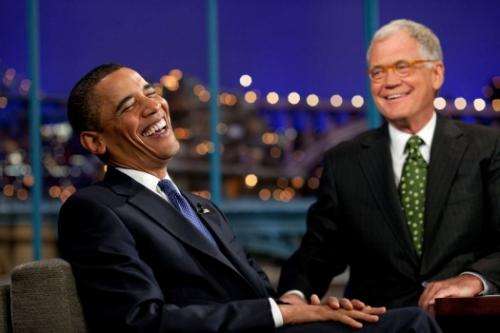
(Phys.org)—The jokes by late-night comedy television hosts can be just as effective as regular political news in spurring discussion among viewers, a new University of Michigan study shows.
In addition, political candidates could help their campaigns with mentions by shows like "The Daily Show with Jon Stewart," "Late Show with David Letterman" or "The Tonight Show with Jay Leno."
"The constructive role of comedy shows evidenced in this study suggests that political entertainment may serve as an important catalyst for revitalized civic life," said Hoon Lee, who conducted the research while seeking his doctorate from the U-M Department of Communication Studies. "This is an important finding, because then political candidates may be willing to use comedy programs to enhance their images."
About 770 people completed an online experiment and a mail survey. The gender breakdown was nearly equal (51 percent female), most were white (74 percent) and the party affiliation was 36 percent Democrat and 34 percent Republican. They were assigned to one of three groups: late-night comedy, television hard news, or control.
The first group of 256 people viewed a short video clip from "The Daily Show" comprising several segments about the government's bailout of big companies. The second group of 254 people was exposed to an "NBC Nightly News" video clip that also featured selected coverage of the government's bailout of big companies. The late-night comedy clip was humorous and sarcastic as Stewart would typically entertain and provoke audiences, whereas the hard news clip remained serious in tone.
The third group, which consisted of 258 people, viewed a clip about a Disney Resort in Orlando. This served as a control providing a baseline comparison for the effects of late-night comedy viewing.
Once participants finished viewing the video clips, they all completed the questionnaire measuring their emotions, attitudes and intentions regarding the economy. Behavioral intentions could include attending a political meeting, rally or speech; contacting a public official or a political party; and displaying a bumper sticker or yard sign on a political issue.
Lee said the findings imply that exposure to late-night comedy limits with whom individuals were willing to discuss politics. In other words, people typically talk about the shows with others who share their beliefs and interests. As a result, the humor-induced discussions may spur political participation.
The research also indicates that while both late-night comedy television and hard news engages audiences, late-night audiences are more likely to use online interaction as a way to comment on political issues.
"The current research suggests that political comedy can play a significant role in the public realm," said Lee, a fellow at the Nam Center for Korean Studies at the U-M International Institute. "Indeed, the results indicate that exposure to late-night satire can enrich deliberative and participatory democracy."
The findings appear in the current issue of Mass Communication and Society.
Journal information: Mass Communication and Society
Provided by University of Michigan


