Hubble spotted a supernova in NGC 5806
Sep 02, 2012
Credit: ESA/NASA, acknowledgement: Andre van der Hoeven

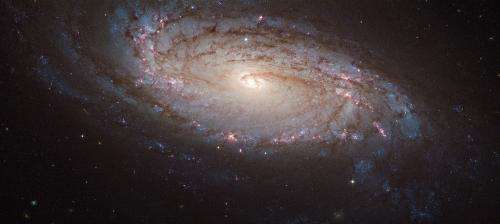
(Phys.org)—A new image from the NASA/ESA Hubble Space Telescope shows NGC 5806, a spiral galaxy in the constellation Virgo (the Virgin). It lies around 80 million light years from Earth. Also visible in this image is a supernova explosion called SN 2004dg.

The exposures that are combined into this image were carried out in early 2005 in order to help pinpoint the location of the supernova, which exploded in 2004. The afterglow from this outburst of light, caused by a giant star exploding at the end of its life, can be seen as a faint yellowish dot near the bottom of the galaxy.

NGC 5806 was chosen to be one of a number of galaxies in a study into supernovae because Hubble's archive already contained high resolution imagery of the galaxy, collected before the star had exploded. Since supernovae are both relatively rare, and impossible to predict with any accuracy, the existence of such before-and-after images is precious for astronomers who study these violent events.

Aside from the supernova, NGC 5806 is a relatively unremarkable galaxy: it is neither particularly large or small, nor especially close or distant.

The galaxy's bulge (the densest part in the center of the ) is a so-called disk-type bulge, in which the extends right to the center of the galaxy, instead of there being a large elliptical bulge of stars present. It is also home to an active galaxy nucleus, a which is pulling in large amounts of matter from its immediate surroundings. As the matter spirals around the black hole, it heats up and emits powerful radiation.

This image is produced from three exposures in visible and infrared light, observed by Hubble's Advanced Camera for Surveys. The field of view is approximately 3.3 by 1.7 arcminutes.

A version of this image was entered into the Hubble's Hidden Treasures Image Processing Competition by contestant Andre van der Hoeven (who won second prize in the competition for his image of Messier 77). Hidden Treasures is an initiative to invite astronomy enthusiasts to search the Hubble archive for stunning images that have never been seen by the general public. The competition has now closed.

Explore further: Hubble spies edge-on beauty

Related Stories

Hubble spies edge-on beauty

May 21, 2012

(Phys.org) -- Visible in the constellation of Andromeda, NGC 891 is located approximately 30 million light-years away from Earth. The NASA/ESA Hubble Space Telescope turned its powerful wide field Advanced ...

A spiral galaxy in Hydra

Apr 09, 2012

(Phys.org) -- This image from the NASA/ESA Hubble Space Telescope shows NGC 4980, a spiral galaxy in the southern constellation of Hydra. The shape of NGC 4980 appears slightly deformed, something which is ...

Hubble spots a bright spark in a nearby spiral galaxy

Jun 11, 2012

(Phys.org) -- This image, taken by the NASA/ESA Hubble Space Telescope, shows a detailed view of the spiral arms on one side of the galaxy Messier 99. Messier 99 is a so-called grand design spiral, with long, ...

Hubble sees the needle galaxy, edge-on and up close

Jul 16, 2012

(Phys.org) -- This image snapped by the NASA/ESA Hubble Space Telescope reveals an exquisitely detailed view of part of the disc of the spiral galaxy NGC 4565. This bright galaxy is one of the most famous ...

Hubble sees a lonely galactic island

Aug 20, 2012

(Phys.org) -- In terms of intergalactic real estate, our solar system has a plum location as part of a big, spiral galaxy, the Milky Way. Numerous, less glamorous dwarf galaxies keep the Milky Way company. ...

Hubble sees a spiral within a spiral

May 28, 2012

(Phys.org) -- NASA's Hubble Space Telescope captured this image of the spiral galaxy known as ESO 498-G5. One interesting feature of this galaxy is that its spiral arms wind all the way into the center, so ...

Recommended for you

Galaxy's Ring of Fire

May 18, 2013

Johnny Cash may have preferred this galaxy's burning ring of fire to the one he sang about falling into in his popular song. The "starburst ring" seen at center in red and yellow hues is not the product of ...

User comments : 0

More news stories

Slow earthquakes: It's all in the rock mechanics

(Phys.org) —Earthquakes that last minutes rather than seconds are a relatively recent discovery, according to an international team of seismologists. Researchers have been aware of these slow earthquakes, ...

Lab sets a new record for creating heralded photons

(Phys.org) —Entanglement, by general consensus of physicists, is the weirdest part of quantum science. To say that two particles, A and B, are entangled means that they are actually two parts of an inseparable ...

Protein study suggests drug side effects are inevitable

A new study of both computer-created and natural proteins suggests that the number of unique pockets – sites where small molecule pharmaceutical compounds can bind to proteins – is surprisingly small, meaning drug side ...

Do salamanders hold the solution to regeneration?

Salamanders' immune systems are key to their remarkable ability to regrow limbs, and could also underpin their ability to regenerate spinal cords, brain tissue and even parts of their hearts, scientists have ...