Excavations in Jaffa confirm presence of Egyptian settlement on the ancient city site
Sep 10, 2012
Cultural Heritage Project. © Martin Peilstöcker + The Jaffa

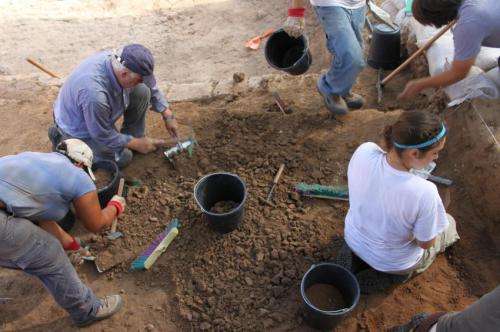
The Old Testament Studies and Biblical Archaeology division of the Faculty of Protestant Theology at Johannes Gutenberg University Mainz (JGU) and the University of California in Los Angeles (UCLA) this year again conducted excavations on the ancient hill of Jaffa in Israel. The recent excavations have not only shed new light on the destruction of elements of the fortification, but also unearthed evidence pointing towards the presence of an Egyptian population on the site.

Historically, Jaffa, now part of the city of Tel Aviv, is the oldest port documented in world history. Ever since the 2nd millennium B.C., Jaffa has been home to intense trading activity. The remains of a gateway belonging to an Egyptian fortification dating to the dynasty of Ramses II (1279-1213 B.C.) had already been discovered during excavations led by the former municipal archaeologist Y. Kaplan in the 1950s. However, the findings from Kaplan's digs have never been extensively published. The Jaffa Cultural Heritage Project, whose partners include the universities in Mainz and Los Angeles as well as the Israeli Antiquities Authority and the Old Jaffa Development Company, not only aims to publish the findings of these older excavations, but also conduct new digs at sites around the city.
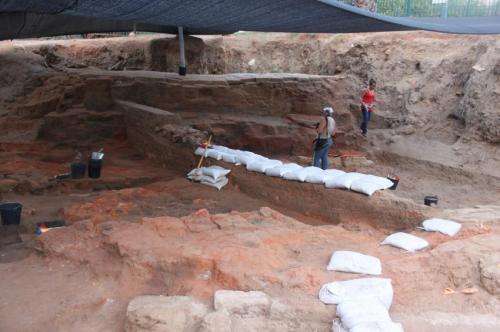
Scorched mud bricks from the fortification gate exposed towards the end of the excavation. © Martin Peilstöcker + The Jaffa Cultural Heritage Project

The goal of this year's excavations was to clarify the history of settlement during the 2nd millennium B.C. by investigating the phases of the fort's destruction and the nature of the Egyptian presence. The German site director Dr. Martin Peilstöcker of JGU explains that it has now become clear that the gate itself was destroyed and rebuilt at least four times. Moreover, it also appears that there is more than just the mud brick architecture and household pottery that reflect Egyptian tradition. In fact, a rare scarab amulet has been found that bears the cartouche of the Egyptian Pharaoh Amenhotep III (1390-1353 B.C.), thus also attesting to the presence of an Egyptian community in the city. Some of the discoveries made during the excavations are to be put on display in a special exhibition at the Bible Experience Museum Frankfurt in 2013.

Explore further: French archaeologists unearth pharaoh boat

add to favorites email to friend print save as pdf

Related Stories

Egypt finds evidence of unfinished ancient tomb

Jun 30, 2010

(AP) -- Egyptian archaeologists who have completed excavations on an unfinished ancient tunnel believe it was meant to connect a 3,300-year-old pharaoh's tomb with a secret burial site, the antiquities department ...

French archaeologists unearth pharaoh boat

Jul 25, 2012

French archaeologists have discovered a roughly 5,000-year-old pharaonic solar boat in an expedition in Abu Rawash, west of the Egyptian capital, the antiquities ministry said on Wednesday.

Satellites discover lost Egyptian pyramids

May 26, 2011

(PhysOrg.com) -- In a new documentary soon to air on BBC, space archaeologist Sarah Parcak from the University of Alabama in Birmingham shares her recent discovery in the relatively new field of space archaeology. ...

Egypt announces find of ancient cat goddess temple

Jan 19, 2010

(AP) -- Archaeologists have unearthed a 2,000-year-old temple that may have been dedicated to the ancient Egyptian cat goddess, Bastet, the Supreme Council of Antiquities said Tuesday.

Recommended for you

Divers begin Lake Michigan search for Griffin ship

Jun 16, 2013

Divers began opening an underwater pit Saturday at a remote site in northern Lake Michigan that they say could be the resting place of the Griffin, a ship commanded by the 17th century French explorer La ...

Lost medieval city found in Cambodia

Jun 15, 2013

A lost medieval city that thrived on a mist-shrouded Cambodian mountain 1,200 years ago has been discovered by archaeologists using revolutionary airborne laser technology, a report said.

User comments : 1

Adjust slider to filter visible comments by rank

Display comments: newest first

jamesdcorner11
not rated yet Sep 12, 2012
I am also an archaeologist, this is really a nice news. I want some more information regarding this, does anyone have more information about jaffa. Please give me. Thanks

More news stories

The hidden agenda of Obama's opposition

Is the US Tea Party movement a racial backlash against President Obama? A new study by Angie Maxwell from the University of Arkansas, and Wayne Parent from Louisiana State University, assesses whether racial attitudes are ...

Dish won't submit revised bid for Sprint

Satellite TV operator Dish Network Corp. said Tuesday it would not submit a revised bid for Sprint, leaving the path open for the wireless carrier to accept what it already considers a superior offer from Japan's Softbank.

Cape Wind gets $200M investment from Danish fund

The Cape Wind offshore wind project has secured a $200 million investment from a Danish pension fund in what the wind farm's president said Tuesday is a milestone for the long-delayed project.