Electronics that flex and stretch like skin
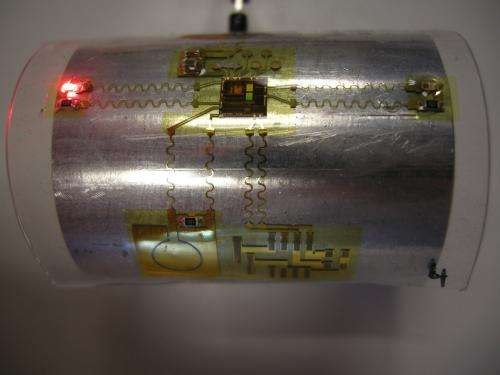
Imec announced today that it has integrated an ultra-thin, flexible chip with bendable and stretchable interconnects into a package that adapts dynamically to curving and bending surfaces. The resulting circuitry can be embedded in medical and lifestyle applications where user comfort and unobtrusiveness is key, such as wearable health monitors or smart clothing. At the 2012 ESTC conference (Electronics System Integration Technology Conference) in Amsterdam (September 17-20, 2012), the researchers will present their results and showcase their latest demonstrations.
Today, most electronic appliances are rigid, or at most mechanically flexible. A growing number of applications, however, require electronics that dynamically adapt to curving and bending surfaces. Some examples include biomedical systems such as unobtrusive, wearable health monitors (e.g. electrocardiogram or temperature sensors), advanced surgical tools, or consumer electronics such as mobile phones embedded in smart textiles. Imec's associated lab at the University of Ghent has pioneered this technology, moving it toward industrial applicability. Industrial partners that want to build a critical lead in this field are welcomed to join the R&D program.
For the demonstration, the researchers thinned a commercially available microcontroller down to 30µm, preserving the electrical performance and functionality. This die was then embedded in a slim polyimide package (40-50µm thick). Next, this ultrathin chip was integrated with stretchable electrical wiring. These were realized by patterning polyimide-supported meandering horseshoe-shaped wires, a technology developed and optimized at the lab. Last, the package is embedded in an elastomeric substrate, e.g. polydimethylsiloxane (PDMS). In this substrate, the conductors behave as two dimensional springs, enabling greater flexibility while preserving conductivity.
"Future electronic circuitry will stretch and bend like rubber or skin while preserving its conductivity," comments Jan Vanfleteren, responsible for the research on flexible and stretchable electronics at imec's Ghent lab. "This breakthrough achievement demonstrates that flexible Ultra-Thin Chip Packages (UTCP) can be integrated with stretchable wiring, paving the way toward fully flexible applications. We anticipate the first appliances will be used in intelligent clothing, with medical applications following later. Once commercial products are introduced, I expect to see clothing with signalization by using LEDs and sensors to track movements."
Provided by IMEC


