New Danish fungal species discovered
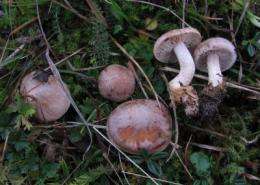
A new fungal species, called Hebelomagriseopruinatum, has now officially been included in the list of species. The fungus, whose name can be translated into 'the grey-dewy tear leaf', was discovered on Zealand in Denmark during a mushroom-hunting tour headed by postdoc Jacob Heilman-Clausen from the University of Copenhagen.
During a mushroom-hunting excursion in 2009, postdoc Jacob Heilman-Clausen from the Center for Macroecology, Evolution and Climate at the Department of Biology, University of Copenhagen, was handed a very interesting looking fungus.
Following thorough expert studies, the fungus has now officially been classified as a novel species.
The fungus has been sighted once before in both England and Germany, but has not been described until the Danish discovery. The scientific description of the fungus has just been published in the journal Fungal Diversity.
"We regularly discover species never previously seen in Denmark, but it is quite extraordinary when a Danish fungus is described as new to the world," says postdoc Jacob Heilman-Clausen.
Intimate cohabitation with plant
The fungus was discovered in Eskebjerg Vesterlyng, an area of natural beauty with old grassy areas and scrub rich in species. Here, the species leads an intimate life with the sun rose plant in the same way as popular edible fungi like chantarelles, boletuses and truffles, which depend on cohabitation with trees.
The new species will, however, hardly be a welcome ingredient in your dinner, as several closely related species are toxic, and according to the researchers this also applies to the new species.
"Edible fungi are very popular in Denmark, but only few people realise that fungi serve important functions in nature. They degrade dead material and ensure that nutrients are circulated to the system. And yet we still know very little about how many fungal species exist worldwide. Even in Denmark, there are still many discoveries like this waiting to be made," says Jacob Heilman-Clausen.
Voluntary fungal enthusiasts valuable to science
The new fungal species was registered by the Danish Fungus Atlas (Danmarks Svampeatlas in Danish), which uses voluntary enthusiasts to map Denmark's fungi.
During the first three project years, some 160,000 discoveries of more than 2,000 species have been entered in the project database, including several species not previously seen in Denmark.
Scheduled to run until 2014, the Danish Fungus Atlas project receives funding from the Aage V. Jensens Naturfond foundation. According to Jacob Heilman-Clausen, there are good opportunities for describing several new species:
"This is the most thorough study of Danish fungi ever. Thanks to the efforts of the volunteers, we will be able to achieve a lot during the short project period. In my opinion, there are many discoveries to be made."
More information: The scientific description of Hebelomagriseopruinatum is published online in the journal Fungal Diversity: www.springerlink.com/content/4 … 343715263602/?MUD=MP
Provided by University of Copenhagen


