Yangtze dolphin's decline mirrored by other animals
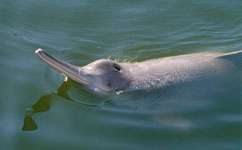
(Phys.org) -- Monitoring numbers of the baiji, the now-extinct freshwater dolphin of the Yangtze river, would also have let researchers track the decline of other threatened animals, including the Yangtze paddlefish and Reeves' shad, a new study shows.
A disproportionate amount of public attention and conservation resources tend to go towards big, impressive animals like the baiji, and the paper – published in PLoS ONE – suggests that conservationists could take advantage of this; research on these creatures could be used indirectly to shed light on the population trends of their less media-friendly neighbours.
The idea that so-called 'charismatic megafauna' like whales and tigers could provide an index of the overall health of their environment isn't new, but it's proved difficult to demonstrate in a rigorous way.
Dr Samuel Turvey of the Institute of Zoology repeatedly travelled to China over the last few years to interview fishermen on the Yangtze about when they last saw various threatened species including the baiji. It's become clear that the baiji is now extinct, but analysing the results of these interviews shows not only that the paddlefish and shad have both declined and may also be extinct, but also that the curves representing their plummeting numbers match that of the baiji very closely.
This was a surprise, as the three animals filled very different ecological niches and on the face of things might be expected to react differently to the same threats and environmental pressures.
'There was no reason to think that these species would have similar patterns of decline over time - they're very different in their ecology and in how they were exploited, although we know that all three were affected by fisheries,' Turvey says. 'There's very little information on the shad and the paddlefish, so we can only infer the pattern of their declines retrospectively - we've only found out what happened to them when it's already too late. Conservation resources are limited and are likely to be focused on charismatic animals, but because the status of such animals can match that of other species, we can at least try to get as much benefit as possible from that.'
One common thread is that all three species used to migrate up and down the river to get to better feeding or breeding grounds, so their reproductive cycles were more easily disrupted by barriers like dams that blocked their passage. They also all suffered badly from overfishing, as well as pollution and other environmental problems. Other non-migratory animals, such as members of the carp and catfish families, are still relatively common in the Yangtze despite its degraded state.
On the other hand, changes in the frequency of sightings of the finless porpoise, another large aquatic mammal that still survives in the Yangtze, weren't linked to those of the other animals.
Turvey isn't sure why. The porpoise isn't migratory, so it doesn't share the feature that could have contributed to the other three species' increased vulnerability. He suggests that because porpoises are still encountered by fishermen fairly regularly, it's harder to document changes to the state of their population using last-sighting reports.
The porpoise is also highly threatened and is declining too, but Turvey is hopeful that efforts to protect it will be more effective than they were for the baiji. Because the river ecosystem has been damaged so badly, the best hope for protecting animals is to set up reserves away from the main river, where animals can be protected and won't face the same fierce environmental pressures. Efforts to do this for the baiji never got off the ground, whereas porpoise reserves are already in place and working well.
He adds that the research could be applied in other river ecosystems with big, media-friendly inhabitants, such as Ganges or Irawaddy dolphins.
More information: Turvey, S.T., Risley, C.L., Barrett, L.A., Hao, Y. & Wang, D. (2012). River dolphins can act as population trend indicators in degraded freshwater systems. PLoS ONE 7(5): e37902.
Journal information: PLoS ONE
Provided by PlanetEarth Online
This story is republished courtesy of Planet Earth online, a free, companion website to the award-winning magazine Planet Earth published and funded by the Natural Environment Research Council (NERC).


