Wireless power for the price of a penny
Aug 09, 2012
Wireless power for the price of a penny

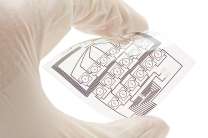
(Phys.org) -- The newspaper-style printing of electronic equipment has led to a cost-effective device that could change the way we interact with everyday objects.

For a price of just one penny per unit the device, known as a rectenna, which is presented today, Friday 10 August, in IOP Publishing's journal Nanotechnology, can be placed onto objects such as , logos and signage so that we can read product information on our smartphones with one simple swipe.

This type of technology, which is known as (), has already been implemented to allow fast money transactions; however, this new device could lead the way to large-scale adoption at a low cost.

The rectenna, created by researchers from Sunchon National University and Paru Printed Electronics Research Institute, could be implemented onto everyday objects so that they can harness the power given off by the smartphone's radio waves and send information back to it via printed digital circuits.

It is called a rectenna as it is a combination of an and a rectifier – a device that converts alternating current (AC) into direct current (DC). The rectenna was printed onto plastic foils in large batches using a roll-to-roll process at a rate of 8m min-1. Five different electronic inks were used and each rectenna had a length of around 1300 mm.

The researchers state that the rectenna can harness power directly from given off by a mobile phone, converting AC into DC. The rectenna created in this study could provide at least 0.3 W of power from an alternating current which had a frequency of 13.56 MHz.

NFC technology is very similar to QR codes, whereby users take a photo of a square-shaped bar code on a poster or advert using their smartphone. The difference with NFC is that items will contain a small computer chip or digital information, operated by DC power.

"What is great about this technique is that we can also print the digital information onto the rectenna, meaning that everything you need for wireless communication is in one place," said co-author of the study Gyoujin Cho.

"Our advantage over current technology is lower cost, since we can produce a roll-to-roll printing process with high throughput in an environmentally friendly manner. Furthermore, we can integrate many extra functions without huge extra cost in the printing process.

"The application of NFC technology with the will be limitless in the near future. The medical, automotive, military and aerospace industries will benefit greatly."

Explore further: Engineers' nanoantennas improve infrared sensing

More information: "Fully roll-to-roll gravure printed rectenna on plastic foils for wireless power transmission at 13.56Mhz" Hyejin Park et al. Nanotechnology 23 344006 (2012) doi:10.1088/0957-4484/23/34/344006 http://iopscience.iop.org/0957-4484/23/34/344006

Related Stories

Recommended for you

Engineers' nanoantennas improve infrared sensing

May 20, 2013

(Phys.org) —A team of University of Pennsylvania engineers has used a pattern of nanoantennas to develop a new way of turning infrared light into mechanical action, opening the door to more sensitive infrared ...

Stacking 2-D materials produces surprising results

May 16, 2013

(Phys.org) —Graphene has dazzled scientists, ever since its discovery more than a decade ago, with its unequalled electronic properties, its strength and its light weight. But one long-sought goal has proved ...

User comments : 5

Adjust slider to filter visible comments by rank

Display comments: newest first

CapitalismPrevails
1 / 5 (1) Aug 10, 2012
What's the power transfer efficiency as %?
brandmixer
5 / 5 (1) Aug 10, 2012
NFC technology is very similar to QR codes

Uh, not at all similar.
PPihkala
5 / 5 (1) Aug 10, 2012
What's the power transfer efficiency as %?

I think it will depend on how close you place your transmitter, in this case your phone with NFC. But important here is not the power efficiency. Important is the capability to exchange information between the NFC tag and NFC device, like your phone. For example if your milk carton had this label, you could read from it when was it manufactured and where. Another important thing here is the price of single label, one penny, because they have to be inexpensive to gain large distribution to cheap products like milk cartons.
CapitalismPrevails
not rated yet Aug 10, 2012
PPihkala, thx for the elaboration. So instead of using bar codes to identify items, we can use this wireless technology?
antonima
not rated yet Aug 10, 2012
Is it really necessary though? A milk carton already has an expiration date on it. Also, they could stick with the image-capture barcode thing that seems to work pretty well for smartphones already.

Fun fact - a gallon of milk at the store doesn't come from a single cow or even a single dairy. They mix milks from many dairies in order to average out antibiotics and such that the cows receive.

More news stories

Radioactive nanoparticles target cancer cells

Cancers of all types become most deadly when they metastasize and spread tumors throughout the body. Once cancer has reached this stage, it becomes very difficult for doctors to locate and treat the numerous tumors that can ...

How gold nanoparticles can help fight ovarian cancer

Positively charged gold nanoparticles are usually toxic to cells, but cancer cells somehow manage to avoid nanoparticle toxicity. Mayo Clinic researchers found out why, and determined how to make the nanoparticles effective ...

B vitamins could delay dementia

(Medical Xpress)—Despite spending billions of dollars on research and development, drug companies have been unable to come up with effective treatments for dementia and Alzheimer's Disease (AD). Now, A. ...

Internet cable from Cuba to Jamaica comes online

A new branch of the Venezuela-to-Cuba undersea fiber-optic cable has reportedly come online, linking the island to nearby Jamaica, increasing Cuba's potential international communications bandwidth and providing a backup ...