Summer storm spins over Arctic
Aug 10, 2012 By Maria-José Viñas
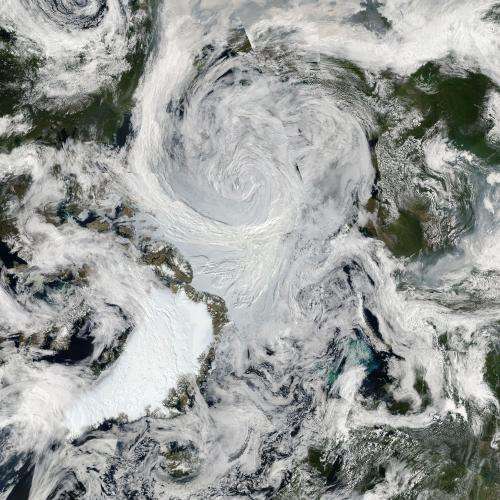
Image mosaic of Arctic storm. (Credit: NASA/Goddard/MODIS Rapid Response Team)

(Phys.org) -- An unusually strong storm formed off the coast of Alaska on August 5 and tracked into the center of the Arctic Ocean, where it slowly dissipated over the next several days.

The Moderate Resolution Imaging Spectroradiometer () on ’s Aqua satellite captured this natural-color mosaic image on Aug. 6, 2012. The center of the storm at that date was located in the middle of the Arctic Ocean.

The storm had an unusually low central pressure area. Paul A. Newman, chief scientist for Atmospheric Sciences at NASA's Goddard Space Flight Center in Greenbelt, Md., estimates that there have only been about eight storms of similar strength during the month of August in the last 34 years of satellite records. “It’s an uncommon event, especially because it’s occurring in the summer. Polar lows are more usual in the winter,” Newman said.

Arctic storms such as this one can have a large impact on the sea ice, causing it to melt rapidly through many mechanisms, such as tearing off large swaths of ice and pushing them to warmer sites, churning the ice and making it slushier, or lifting warmer waters from the depths of the .

“It seems that this storm has detached a large chunk of ice from the main sea ice pack. This could lead to a more serious decay of the summertime ice cover than would have been the case otherwise, even perhaps leading to a new Arctic sea ice minimum,” said Claire Parkinson, a climate scientist with NASA Goddard. “Decades ago, a storm of the same magnitude would have been less likely to have as large an impact on the , because at that time the ice cover was thicker and more expansive.”

Aqua passes over the poles many times a day, and the MODIS Rapid Response System stitches together images from throughout each day to generate a daily mosaic view of the . This technique creates the diagonal lines that give the image its "pie slice" appearance.

In the image, the bright white ice sheet of Greenland is seen in the lower left.

Explore further: Alaska volcano shoots ash 15,000 feet into the air

add to favorites email to friend print save as pdf

Related Stories

Declining sea ice to lead to cloudier Arctic: study

Mar 31, 2012

Arctic sea ice has been declining over the past several decades as global climate has warmed. In fact, sea ice has declined more quickly than many models predicted, indicating that climate models may not be correctly representing ...

Arctic ice gets a check up

Mar 31, 2011

Scientists tracking the annual maximum extent of Arctic sea ice said that 2011 was among the lowest ice extents measured since satellites began collecting the data in 1979. Using satellites to track Arctic ice and comparing ...

NASA Sees Rapid Changes in Arctic Sea Ice

Sep 13, 2006

NASA data shows that Arctic perennial sea ice, which normally survives the summer melt season and remains year-round, shrunk abruptly by 14 percent between 2004 and 2005. According to researchers, the loss of perennial ice ...

Annual Arctic sea ice less reflective than old ice

May 17, 2012

In the Arctic Ocean, the blanket of permanent sea ice is being progressively replaced by a transient winter cover. In recent years the extent of the northern ocean's ice cover has declined. The summer melt season is starting ...

Recommended for you

Alaska volcano shoots ash 15,000 feet into the air

May 18, 2013

(AP)—One of Alaska's most restless volcanoes has shot an ash cloud 15,000 feet into the air in an ongoing eruption that has drawn attention from a nearby community but isn't expected to threaten air traffic.

NASA sees Cyclone Mahasen hit Bangladesh

May 17, 2013

NASA's Tropical Rainfall Measuring Mission satellite known as TRMM measured Cyclone Mahasen's rainfall rates from space as it made landfall on May 16. Mahasen has since dissipated over eastern India.

Rapid climate change ruled out ice age trees

May 17, 2013

Short, sharp fluctuations in the Earth's climate throughout the last ice age may have stopped trees from getting a foothold in Europe and northern Asia, scientists say.

Earth's iron core is surprisingly weak, researchers say

May 17, 2013

The massive ball of iron sitting at the center of Earth is not quite as "rock-solid" as has been thought, say two Stanford mineral physicists. By conducting experiments that simulate the immense pressures deep in the planet's ...

User comments : 0

More news stories

Russia retrieves mice, newts from space

A Russian capsule filled with 45 mice and 15 newts along with other small animals returned from a month's mission in orbit on Sunday with data scientists hope will pave the way for a manned flight to Mars.

Galaxy's Ring of Fire

Johnny Cash may have preferred this galaxy's burning ring of fire to the one he sang about falling into in his popular song. The "starburst ring" seen at center in red and yellow hues is not the product of ...

Honeybees trained in Croatia to find land mines

(AP)—Mirjana Filipovic is still haunted by the land mine blast that killed her boyfriend and blew off her left leg while on a fishing trip nearly a decade ago. It happened in a field that was supposedly ...

German energy shift faces headwinds

Tense engineers have their eyes peeled on complex colour-coded diagrams on a wall-sized screen that makes their control room look like the inside of a spaceship.