Hubble watches star clusters on a collision course
Aug 16, 2012
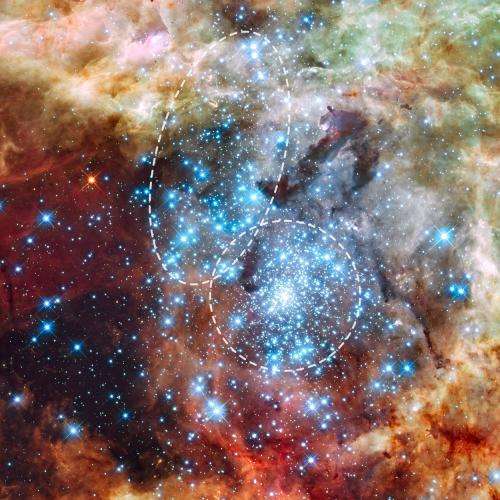
This is a Hubble Space Telescope image of a pair of star clusters that are believed to be in the early stages of merging. The clusters lie in the gigantic 30 Doradus nebula, which is 170,000 light-years from Earth. The Hubble observations, made with the Wide Field Camera 3, were taken Oct. 20-27, 2009. The blue color is light from the hottest, most massive stars; the green from the glow of oxygen; and the red from fluorescing hydrogen. Credit: NASA, ESA, R. O'Connell (University of Virginia), and the Wide Field Camera 3 Science Oversight Committee

(Phys.org) -- Astronomers using data from NASA's Hubble Space Telescope have caught two clusters full of massive stars that may be in the early stages of merging. The clusters are 170,000 light-years away in the Large Magellanic Cloud, a small satellite galaxy to our Milky Way.

What at first was thought to be only one cluster in the core of the massive star-forming region 30 Doradus (also known as the Tarantula Nebula) has been found to be a composite of two clusters that differ in age by about one million years.

The entire 30 Doradus complex has been an active star-forming region for 25 million years, and it is currently unknown how much longer this region can continue creating new stars. Smaller systems that merge into larger ones could help to explain the origin of some of the largest known star clusters.

Lead scientist Elena Sabbi of the Science Institute in Baltimore, Md., and her team began looking at the area while searching for runaway stars, fast-moving stars that have been kicked out of their stellar nurseries where they first formed. "Stars are supposed to form in clusters, but there are many young stars outside 30 Doradus that could not have formed where they are; they may have been ejected at very from 30 Doradus itself," Sabbi said.

She then noticed something unusual about the cluster when looking at the distribution of the low-mass stars detected by Hubble. It is not spherical, as was expected, but has features somewhat similar to the shape of two merging galaxies where their shapes are elongated by the tidal pull of gravity. Hubble's circumstantial evidence for the impending merger comes from seeing an elongated structure in one of the clusters, and from measuring a different age between the two clusters.

According to some models, the giant gas clouds out of which form may fragment into smaller pieces. Once these small pieces precipitate stars, they might then interact and merge to become a bigger system. This interaction is what Sabbi and her team think they are observing in 30 Doradus.

Also, there are an unusually large number of high-velocity stars around 30 Doradus. Astronomers believe that these stars, often called "runaway stars" were expelled from the core of 30 Doradus as the result of dynamical interactions. These interactions are very common during a process called core collapse, in which more- sink to the center of a cluster by dynamical interactions with lower-mass stars. When many massive stars have reached the core, the core becomes unstable and these massive stars start ejecting each other from the cluster.

The big cluster R136 in the center of the 30 Doradus region is too young to have already experienced a core collapse. However, since in smaller systems the core collapse is much faster, the large number of that has been found in the 30 Doradus region can be better explained if a small cluster has merged into R136.

Follow-up studies will look at the area in more detail and on a larger scale to see if any more clusters might be interacting with the ones observed. In particular, the infrared sensitivity of NASA's planned James Webb Space Telescope (JWST) will allow astronomers to look deep into the regions of the that are obscured in visible-light photographs. In these areas cooler and dimmer stars are hidden from view inside cocoons of dust. Webb will better reveal the underlying population of stars in the nebula.

The 30 Doradus Nebula is particularly interesting to astronomers because it is a good example of how star-forming regions in the young universe may have looked. This discovery could help scientists understand the details of cluster formation and how formed in the early universe.

Explore further: South Africa's new radio telescope reveals giant outbursts from binary star system

Related Stories

Drama in the heart of the Tarantula

Dec 11, 2008

Found in the nearby Large Magellanic Cloud, 30 Doradus is one of the largest massive star forming regions close to the Milky Way. Enormous stars in 30 Doradus, also known as the Tarantula Nebula, are producing ...

Hubble views grand star-forming region

Mar 09, 2012

(PhysOrg.com) -- This massive, young stellar grouping, called R136, is only a few million years old and resides in the 30 Doradus Nebula, a turbulent star-birth region in the Large Magellanic Cloud, a satellite ...

The Tarantula glows with X-rays and infrared light

Nov 11, 2011

(PhysOrg.com) -- This spiderweb-like tangle of gas and dust is a star-forming region called 30 Doradus. It is one of the largest such regions located close to the Milky Way galaxy, and is found in the neighboring ...

Recommended for you

Galaxy's Ring of Fire

11 hours ago

Johnny Cash may have preferred this galaxy's burning ring of fire to the one he sang about falling into in his popular song. The "starburst ring" seen at center in red and yellow hues is not the product of ...

4C+29.30: Black hole powered jets plow into galaxy

May 15, 2013

(Phys.org) —This composite image of a galaxy illustrates how the intense gravity of a supermassive black hole can be tapped to generate immense power. The image contains X-ray data from NASA's Chandra X-ray ...

A space-time magnifying glass

May 15, 2013

(Phys.org) —Bright arcs are smeared around the heart of galaxy cluster Abell S1077 in this image taken by the NASA/ESA Hubble space telescope. The arcs are stretched images of distant galaxies distorted ...

User comments : 4

Adjust slider to filter visible comments by rank

Display comments: newest first

Caliban
not rated yet Aug 17, 2012
It's not clear from the image, but it appears to me that there may even be a helical component to the movement of the two clusters relative to each other as they approach. Wonder how this would look in a 3D rendering, with some kind of tagging of the two clusters' component stars?
cantdrive85
1 / 5 (2) Aug 19, 2012
Lot's of assumptions and conclusions based upon assumptions which lead to even more assumptions in this article, not sure how that qualifies as science. Metaphysics maybe, science, no!
vidyunmaya
1 / 5 (3) Aug 20, 2012
Sub: Heart and Center of Universe-1.7x10^5 LY
The two regions are crystal clear indication to Twin heart Mode of the Universe. The Knowledge Expansion must be viewed from and above this zone. Origins-Cosmology needs best of brains trust.
See Cosmology Vedas Interlinks-Vidyardhi Nanduri
Deathclock
not rated yet Aug 20, 2012
Lot's of assumptions and conclusions based upon assumptions which lead to even more assumptions in this article, not sure how that qualifies as science. Metaphysics maybe, science, no!


NASA has put several car-sized rovers on Mars, and they have space probes entering interstellar space as we speak... what have you done?

You're likely a nobody, with no real education in the natural sciences, who has no business criticizing the work of an organization that has proven it's efficacy many times over. You likely don't have the background knowledge required to even begin to construct a valid criticism of ANYTHING that they present.

More news stories

Galaxy's Ring of Fire

Johnny Cash may have preferred this galaxy's burning ring of fire to the one he sang about falling into in his popular song. The "starburst ring" seen at center in red and yellow hues is not the product of ...

Alaska volcano shoots ash 15,000 feet into the air

(AP)—One of Alaska's most restless volcanoes has shot an ash cloud 15,000 feet into the air in an ongoing eruption that has drawn attention from a nearby community but isn't expected to threaten air traffic.

Chinese, Indian airlines face EU pollution fines

Eight Chinese and two Indian airlines face fines of up to several million euros for not paying for their greenhouse gas emissions during flights within the bloc, the European Commission said on Friday.

US seizes Bitcoin operator accounts

US authorities seized the accounts of a Bitcoin digital currency exchange operator, claiming it was functioning as an "unlicensed money service business," court documents showed Friday.

Morocco to harness the wind in energy hunt

Morocco is ploughing ahead with a programme to boost wind energy production, particularly in the southern Tarfaya region, where Africa's largest wind farm is set to open in 2014.