Signs changing fast for Voyager at solar system edge
Aug 03, 2012
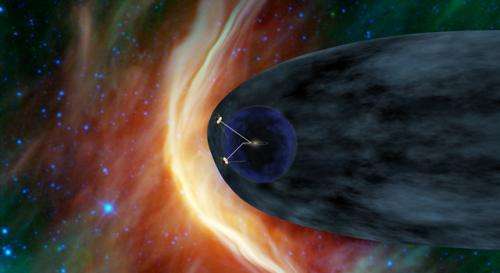
This artist's concept shows NASA's two Voyager spacecraft exploring a turbulent region of space known as the heliosheath, the outer shell of the bubble of charged particles around our sun. Image credit: NASA/JPL-Caltech

(Phys.org) -- Two of three key signs of changes expected to occur at the boundary of interstellar space have changed faster than at any other time in the last seven years, according to new data from NASA's Voyager 1 spacecraft.

For the last seven years, 1 has been exploring the outer layer of the bubble of charged particles the sun blows around itself. In one day, on July 28, data from Voyager 1's cosmic ray instrument showed the level of high-energy originating from outside our solar system jumped by five percent. During the last half of that same day, the level of lower- originating from inside our solar system dropped by half. However, in three days, the levels had recovered to near their previous levels.

A third key sign is the direction of the magnetic field, and scientists are eagerly analyzing the data to see whether that has, indeed, changed direction. Scientists expect that all three of these signs will have changed when Voyager 1 has crossed into interstellar space. A preliminary analysis of the latest magnetic field data is expected to be available in the next month.

"These are thrilling times for the Voyager team as we try to understand the quickening pace of changes as Voyager 1 approaches the edge of interstellar space," said Edward Stone, the Voyager project scientist based at the California Institute of Technology, Pasadena, Calif. "We are certainly in a new region at the edge of the solar system where things are changing rapidly. But we are not yet able to say that Voyager 1 has entered interstellar space."

The levels of high-energy have been increasing for years, but more slowly than they are now. The last jump -- of five percent -- took one week in May. The levels of lower-energy particles from inside our have been slowly decreasing for the last two years. Scientists expect that the lower-energy particles will drop close to zero when Voyager 1 finally crosses into interstellar space.

"The increase and the decrease are sharper than we've seen before, but that's also what we said about the May data," Stone said. "The data are changing in ways that we didn't expect, but Voyager has always surprised us with new discoveries."

Voyager 1, which launched on Sept. 5, 1977, is 11 billion miles (18 billion kilometers) from the sun. Voyager 2, which launched on Aug. 20, 1977, is close behind, at 9.3 billion miles (15 billion kilometers) from the sun.

"Our two veteran Voyager spacecraft are hale and healthy as they near the 35th anniversary of their launch," said Suzanne Dodd, Voyager project manager based at 's Jet Propulsion Laboratory, Pasadena. "We know they will cross into . It's just a question of when."

Explore further: Data from Voyager 1 point to interstellar future

Related Stories

Recalculating the distance to interstellar space

Jun 15, 2011

(PhysOrg.com) -- Scientists analyzing recent data from NASA's Voyager and Cassini spacecraft have calculated that Voyager 1 could cross over into the frontier of interstellar space at any time and much earlier ...

Voyager 1 hits new region at solar system edge

Dec 05, 2011

(PhysOrg.com) -- NASA's Voyager 1 spacecraft has entered a new region between our solar system and interstellar space. Data obtained from Voyager over the last year reveal this new region to be a kind of cosmic ...

Data from Voyager 1 point to interstellar future

Jun 15, 2012

(Phys.org) -- Data from NASA's Voyager 1 spacecraft indicate that the venerable deep-space explorer has encountered a region in space where the intensity of charged particles from beyond our solar system has ...

Voyager 1 at the final frontier

Jun 22, 2012

For nearly 35 years, NASA’s Voyager 1 probe has been hurtling toward the edge of the solar system, flying through the dark void on a mission unlike anything attempted before. One day, mission controllers ...

Five things about NASA's Voyager mission

Apr 27, 2011

(PhysOrg.com) -- Here are five facts about NASA's twin Voyager 1 and 2 spacecraft, the longest continuously-operating spacecraft in deep space. The Voyagers were built by NASA's Jet Propulsion Laboratory in ...

Recommended for you

Dark, massive asteroid to fly by Earth on May 31

19 hours ago

It's 1.7 miles long. Its surface is covered in a sticky black substance similar to the gunk at the bottom of a barbecue. If it impacted Earth it would probably result in global extinction. Good thing it is ...

Research team explains 'Lazarus' comets

22 hours ago

Astronomers from the University of Antioquia have discovered a graveyard of comets. These once-dormant comets, dubbed by astronomers as "The Lazarus comets," are now rejuvenated.

NASA ships sensors for seafaring satellite to France

23 hours ago

(Phys.org) —Three NASA-built instruments that are integral components of the next in a series of U.S./European ocean altimetry satellites have arrived in France for integration with their spacecraft in ...

Trip into space with DiCaprio costs $1.55m

23 hours ago

Leonardo DiCaprio is going to get closer to stars of a different kind as he heads into space aboard the Virgin Galactic, and a well-heeled bidder at the Cannes Film Festival has paid 1.2 million euros (1.5 million) to be ...

User comments : 14

Adjust slider to filter visible comments by rank

Display comments: newest first

Q-Star
4.2 / 5 (21) Aug 03, 2012
"Our two veteran Voyager spacecraft are hale and healthy as they near the 35th anniversary of their launch,"

Kudos NASA and JPL, you sure got our money's worth out of those two.
ACW
5 / 5 (12) Aug 03, 2012
I remember the excitement that the Voyagers created during their "Grand Tour" of the Solar System. Truly those craft have proven themselves to be among NASA's greatest achievements.
Benni
4.4 / 5 (11) Aug 03, 2012
I just love science & scientific endeavor.

When I was 5 years old I told my Dad one night standing in the backyard beneath a sky blanketed with stars, that I wanted to be a scientist when I grow up. I grew up, I'm a scientist/engineer, I admire my colleagues who have worked so hard to give me knowledge about our Universe that I just don't have enough available time in one lifetime to indulge in.

Thank you so much Voyager team for decades of dedication, all the hats I own are off to you, and none of them are "tin-foil".
rah
5 / 5 (5) Aug 03, 2012
Great work NASA. I hope the Mars Science Laboratory does half as well Sunday night.
Raygunner
5 / 5 (6) Aug 03, 2012
I for one will definitely be watching when the Mars Curiosity lands at 1:30am EST Monday morning. If NASA can just pull off that amazing landing sequence... the complexity is unbelievable. Here's hoping they "stick" the landing - at under 2 mph of course - and we should have video of the landing as well. The Voyager has been part of the science discussion for almost 35 years now and here's hoping for at least 10 more.
Vendicar_Decarian
1.4 / 5 (11) Aug 03, 2012
Andrew L. Gasser launched Tea Party In Space in June as a way to bring fiscal responsibility into the space program, he told TPM Tuesday. He called the group, which was formed in conjunction with the South Florida Tea Party, the first issue-specific tea party in the country.

Gasser explained that the group aims to bring the free markets into the space program, because right now, he say, there is only the government which amounts to socialism. It is socialism when you have the government coming down and saying, this is what we want to build, and this is how we want you to build it, he said.
TheGhostofOtto_Loves_RitchieGuy
1.4 / 5 (9) Aug 04, 2012
and he was so right, Darling. Let's have a tea party, just you and me.
TheGhostofOtto_Loves_RitchieGuy
1.4 / 5 (9) Aug 04, 2012
Whoops. I didn't mean you, Vendi. Sorry about that. I was talking to someone else.
Shootist
1.6 / 5 (7) Aug 04, 2012
"Our two veteran Voyager spacecraft are hale and healthy as they near the 35th anniversary of their launch,"

Kudos NASA and JPL, you sure got our money's worth out of those two.


Nothing like building with cast iron and plutonium.
Caliban
1 / 5 (1) Aug 04, 2012
"Our two veteran Voyager spacecraft are hale and healthy as they near the 35th anniversary of their launch,"

Kudos NASA and JPL, you sure got our money's worth out of those two.


Nothing like building with cast iron and plutonium.


That's right, shooty-

Mission conditions and objectives dictate equipment construction materials. Papier-mache and AAs probably wouldn't have held up very well in an operating environment of near-zero temperatures, constant hard radiation and the continual bombardment of micrometeorites.

The selection of materials wasn't then --nor is it now-- an example of "sledgehammer" technology.

That being said, however --I do agree with you that, for precisely that reason, it is grounds for a Caveman-style admiration. Not a bad thing.
Mastoras
4 / 5 (1) Aug 05, 2012
A very rare discussion thread, where all comments got only a 5. Amd then it was tea time...
-.
Argiod
1 / 5 (1) Aug 06, 2012
I once asked a NASA friend why we don't have cars that are that well built. His reply was that I could, if I were willing to pay several million dollars for it.
vidyunmaya
1 / 5 (3) Aug 06, 2012
Sub: Change in orientation
Plasma Regulated Electromagnetic Phenomena in magnetic Field Environment- cosmology Vedas Interlinks -provide critical orientation modes.Please provide more Specific information -voyager I and Voyager II- with reference Sun.
Vidyardhicosmology.blogspot.com
randblee
not rated yet Aug 06, 2012
Tremendously exciting. And the interest in the Curiosity landing on Mars last night was so strong that most of the NASA websites live streaming the event were overwhelmed. That bodes well for the future of science, if we can keep from blowing ourselves up, of course....

More news stories

Galaxies fed by funnels of fuel

(Phys.org) —Computer simulations of galaxies growing over billions of years have revealed a likely scenario for how they feed: a cosmic version of swirly straws.

Source of life running out: water scientists

The majority of people on Earth people will face severe water shortages within a generation or two if pollution and waste continues unabated, scientists warned at a conference in Bonn Friday.

Dark, massive asteroid to fly by Earth on May 31

It's 1.7 miles long. Its surface is covered in a sticky black substance similar to the gunk at the bottom of a barbecue. If it impacted Earth it would probably result in global extinction. Good thing it is ...

Yahoo, pay-TV operators among Hulu bidders

Online video site Hulu is again up for sale, with Yahoo and pay TV operators DirecTV and Time Warner Cable among the seven bidders, according to a person with direct knowledge of the matter.

Heart failure accelerates male 'menopause'

Heart failure accelerates the aging process and brings on early andropausal syndrome (AS), according to research presented today at the Heart Failure Congress 2013. AS, also referred to as male 'menopause', was four times ...

Radiation leak at Japan lab; small impact expected

An atomic research lab in northern Japan has reported a radiation leak that may have affected about 50 people, though none were hospitalized and no impact was expected outside the facility, the lab's operator ...

Feds fight morning-after pill age ruling in NY

(AP)—Department of Justice lawyers have again asked a federal appeals court in New York to delay lifting age restrictions and prescription requirements on an emergency contraceptive popularly known as the morning-after ...