Salt-tolerant chickpea project to boost crop production
Jul 09, 2012
Salt-tolerant chickpea project to boost crop production
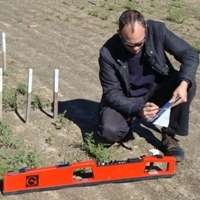
Research Officer Mr. John Quealy measuring soil salinity in field evaluations of chickpea lines on saline soil at Bindi Bindi in the WA grainbelt.

Researchers at The University of Western Australia, in collaboration with research partners overseas, have identified which lines of chickpea grow better in moderately salty soil.

Winthrop Professor Timothy Colmer, from UWA's School of and UWA's Institute of Agriculture, said the project involved researchers from the University of Sussex in the United Kingdom, the International Institute for the Semi-Arid Tropics in India and the Centre for Legumes in Mediterranean Agriculture at UWA.

The project was funded by the Australian Research Council through its Linkage Project scheme and the industry partner was Council of Grain Growers Organization.

"Soil salinity impedes in many parts of the world, including large areas of farming land in Australia and India," Professor Colmer said.

" is a salt-sensitive , so improvement in its is a priority.  The present research has highlighted that a previously widely-grown cultivar in WA (Rupali) is particularly salt sensitive.

"Many chickpea genotypes are very salt-sensitive and so suffer damage even on moderately saline soils that have little impact on bread wheat - impacting on the potential yields of chickpea in rotation with wheat on areas with sub-soil salinity."

Winthrop Professor Kadambot Siddique, Director of UWA's Institute of Agriculture and Co-Chief Investigator of the project, said genotypes with greater salt tolerance were identified and had been used as parents in the breeding program in WA and India.

The aim was to add this moderate level of salt tolerance to the new Ascochyta blight-resistant lines being developed by the breeding program.

Professor Siddique said the project had provided greater understanding of chickpea's salt tolerance and advanced breeding lines would be evaluated in follow-up work.  The research had also made initial steps towards development of molecular markers to enhance future breeding strategies to improve salt tolerance in chickpea, he said. 

Explore further: Rice blast research reveals details on how a fungus invades plants

add to favorites email to friend print save as pdf

Related Stories

Researchers develop highest yielding salt tolerant wheat

Apr 15, 2010

(PhysOrg.com) -- In a major breakthrough for wheat farmers in salt-affected areas, CSIRO researchers have developed a salt tolerant durum wheat that yields 25 per cent more grain than the parent variety in ...

Crop root study to boost Australian grain production

May 09, 2012

Researchers at The University of Western Australia say that "next frontier" of agricultural science is understanding the root system and function of crop plants to significantly increase Australian grain production, ...

Time to test pulse seed for Ascochyta

Mar 02, 2011

Researchers at Montana State University are seeing an increase in the number of samples of pulse crops containing actionable amounts of Ascochyta in 2011 as compared to 2010. This is probably due to delayed harvesting this ...

Can bedding plants thrive with recyled water?

Dec 30, 2010

To conserve dwindling water resources, municipalities are encouraging the use of "recycled water", municipal wastewater that has been extensively treated and deemed safe to reuse for irrigation and other purposes. Using recycled ...

Recommended for you

Gene discovery leads to new OPP test

Jun 18, 2013

The discovery of a gene associated with a persistent viral infection that causes an incurable disease—ovine progressive pneumonia (OPP)—in sheep has led to the development of a genetic test that can be ...

Genome sequence for mother of ash dieback survival

Jun 17, 2013

The first sequence data for a survivor of the ash dieback epidemic has been made available by scientists from The Genome Analysis Centre (TGAC) as part of a research collaboration led by the John Innes Centre and The Sainsbur ...

User comments : 0

More news stories

Surprise species at risk from climate change

(Phys.org) —Most species at greatest risk from climate change are not currently conservation priorities, according to an International Union for Conservation of Nature (IUCN) study that has introduced a ...

Origins of 'The Hoff' crab revealed (w/ Video)

The history of a new type of crab, nicknamed 'The Hoff' because of its hairy chest, which lives around hydrothermal vents deep beneath the Southern Ocean and Indian Ocean, has been revealed for the first ...

EUROnu project recommends building Neutrino Factory

(Phys.org) —The European Union's Seventh Framework Programme, EUROnu, has submitted its findings to a panel at CERN. Charged with choosing a project to study the nature of matter and antimatter, the project ...

Antioxidant shows promise in Parkinson's disease

Diapocynin, a synthetic molecule derived from a naturally occurring compound (apocynin), has been found to protect neurobehavioral function in mice with Parkinson's Disease symptoms by preventing deficits in motor coordination.