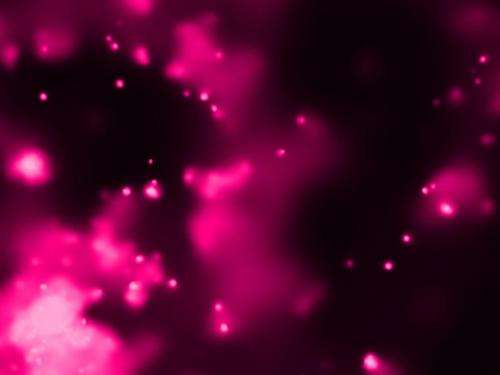
Image: Black hole outburst in spiral galaxy M83
Jul 16, 2012
Image Credit: NASA/CXC/Curtin University/R.Soria et al.

(Phys.org) -- NASA's Chandra X-ray Observatory has discovered an extraordinary outburst by a black hole in the spiral galaxy M83 (Messier 83), located about 15 million light years from Earth.

Using Chandra, astronomers found a new ultraluminous X-ray source, or ULX.

These objects give off more X-rays than most normal binary systems in which a is in orbit around a neutron star or black hole.

Messier 83 is a barred spiral galaxy approximately 15 million light years away in the constellation Hydra. It is one of the closest and brightest barred spiral galaxies in the sky, making it visible with binoculars. Six supernovae have been observed in M83.

Explore further: Image: Black hole caught in a stellar homicide

add to favorites email to friend print save as pdf

Related Stories

Classic portrait of a barred spiral galaxy

Feb 03, 2012

(PhysOrg.com) -- The NASA/ESA Hubble Space Telescope has taken a picture of the barred spiral galaxy NGC 1073, which is found in the constellation of Cetus (The Sea Monster). Our own galaxy, the Milky Way, ...

Andromeda galaxy pops up ultraluminous X-ray sources

Feb 27, 2012

(PhysOrg.com) -- Researchers using NASA's Chandra X-ray Observatory, Hubble Space Telescope, Swift Gamma-ray Burst Explorer and the European Space Agency's XMM-Newton Observatory have been studying an object ...

Chandra finds nearest pair of supermassive black holes

Aug 31, 2011

(PhysOrg.com) -- Astronomers have used NASA's Chandra X-ray Observatory to discover the first pair of supermassive black holes in a spiral galaxy similar to the Milky Way. At a distance of 160 million light ...

Image: Black hole caught in a stellar homicide

Jul 12, 2012

(Phys.org) -- This computer-simulated image shows gas from a star that is ripped apart by tidal forces as it falls into a black hole. Some of the gas also is being ejected at high speeds into space.

Midsummer's Dream Galaxies

Aug 10, 2005

What does the galaxy in which we live look like? It is almost certain that we will never be able to send a probe out of our Milky Way to take a snapshot, in the same way as the first satellites could do t ...

Recommended for you

NASA head views progress on asteroid lasso mission

8 hours ago

Surrounded by engineers, NASA chief Charles Bolden inspected a prototype spacecraft engine that could power an audacious mission to lasso an asteroid and tow it closer to Earth for astronauts to explore.

Ecuador satellite collides with Russian space junk

8 hours ago

A small Ecuadoran satellite collided in orbit with the remains of a Russian rocket, but it is too soon to know how much damage it might have sustained, Quito's space agency said Thursday.

Forecast for Titan: Wild weather could be ahead

May 22, 2013

(Phys.org) —Saturn's moon Titan might be in for some wild weather as it heads into its spring and summer, if two new models are correct. Scientists think that as the seasons change in Titan's northern hemisphere, ...

SDO observes mid-level solar flare

May 22, 2013

UPDATE 16:30 p.m. EDT: The M7-class flare was also associated with a coronal mass ejection or CME, another solar phenomenon that can send billions of tons of particles into space. While this CME was not Ea ...

User comments : 0

More news stories

A hidden population of exotic neutron stars

(Phys.org) —Magnetars – the dense remains of dead stars that erupt sporadically with bursts of high-energy radiation - are some of the most extreme objects known in the Universe. A major campaign using ...

Hubble reveals the ring nebula's true shape

(Phys.org) —The Ring Nebula's distinctive shape makes it a popular illustration for astronomy books. But new observations by NASA's Hubble Space Telescope of the glowing gas shroud around an old, dying, ...

NASA head views progress on asteroid lasso mission

Surrounded by engineers, NASA chief Charles Bolden inspected a prototype spacecraft engine that could power an audacious mission to lasso an asteroid and tow it closer to Earth for astronauts to explore.

Controlling mood through the motions of mitochondria

(Medical Xpress)—Regulating the distribution of power in neurons is done by a system that makes the national electric grid look simple by comparison. Each neuron has several thousand mitochondria confined ...

A quantum simulator for magnetic materials

Physicists understand perfectly well why a fridge magnet sticks to certain metallic surfaces. But there are more exotic forms of magnetism whose properties remain unclear, despite decades of intense research. ...