June 13, 2012 weblog
Uncanny Valley robots essay resurfaces 42 years later
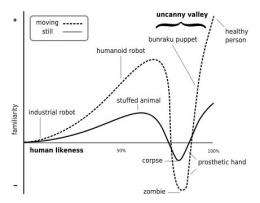
(Phys.org) -- An essay on robots by a professor in Japan over 40 years ago has just got its official translation. Many in robotics and other science circles will say better late than never for an official translation of Yasahiro Mori's paper, “The Uncanny Valley” which was published in a Japanese journal called Energy 42 years earlier. The essay has generated interest about the extent and limitations of making robots more and more human-like in human-robot interaction. An English translation was done in 2005 but the translation that has been authorized and and reviewed by Mori was published Tuesday in IEEE Spectrum.
“I have noticed that, in climbing toward the goal of making robots appear human, our affinity for them increases until we come to a valley (Figure 1), which I call the uncanny valley.” That observation from his original essay is what sparked conversations and interest among robotic designers over the years. Mori maintains that humans are drawn to human-like robots with positive feelings of affinity until the robot moves or reveals itself in such a way that triggers the person’s realization that it is not human. Then it becomes “uncanny” or in popular-culture terms, creepy. Affinity is lost.
In his essay, Mori expressed this experience in a graph, and he also offered an example, the prosthetic hand. The human being gets an “eerie sensation,” he said, when realizing that the hand is not real. “We could be startled during a handshake by its limp boneless grip together with its texture and coldness. When this happens, we lose our sense of affinity, and the hand becomes uncanny. In mathematical terms, this can be represented by a negative value.” He adds that when a prosthetic hand that is near the bottom of the uncanny valley starts to move, the sensation of eeriness intensifies.
The official translation on Tuesday is accompanied by an interview with Mori, who can look at the validity of his remarks 42 years later, when robotics has gone through so many developments. A counterpoint to the popularity of Mori’s essay has been the contention that the essay was an essay, after all, of limited scientific value.
Mori said, “I have read that there is scientific evidence that the uncanny valley does indeed exist; for example, by measuring brain waves scientists have found evidence of that. I do appreciate the fact that research is being conducted in this area, but from my point of view, I think that the brain waves act that way because we feel eerie. It still doesn't explain why we feel eerie to begin with.“
Mori said that pointing out the existence of the uncanny valley was intended as advice for people who design robots rather than a scientific statement itself.
Mori said he still thinks that designers should steer clear of making robots too lifelike, falling into the valley. ” I have no motivation to build a robot that resides on the other side of the valley…Why do you have to take the risk and try to get closer to the other side?” He said he did not even find it interesting to develop a robot that looks “exactly” like a human.
Mori spoke approvingly about Asimo as “invigorating,” a robot inviting positive feelings but appearing as different from humans.
The two translators of the essay are Karl F. MacDorman, associate professor of human computer interaction at the School of Informatics, Indiana University. and Norri Kageki, a journalist who writes about robots.
More information:
spectrum.ieee.org/automaton/ro … s/the-uncanny-valley
spectrum.ieee.org/automaton/ro … n-the-uncanny-valley
© 2012 Phys.Org


