Research sheds light on how Southeast Asia evolved from hunter gatherer to farming society
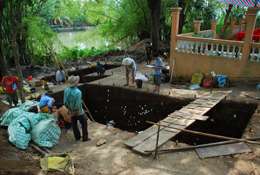
The possible discovery of the earliest toilet in Southern Vietnam could give up clues about how Southeast Asia evolved from a traditional hunter gatherer society to a farming community, new research from The Australian National University reveals.
Dr. Marc Oxenham led a team of Australian and Vietnamese specialists on a seven-week archaeological excavation of a 3,300 to 3,700 year old Neolithic village site in Southern Vietnam earlier this year. ‘Rach Nui’ is a 5-metre tall ancient human-made mound surrounded by small tidal streams and mangrove swamps. The site is about 30km south of modern-day Ho Chi Minh City.
The team believe they found Vietnam’s earliest latrine when they stumbled across more than 30 preserved faeces belonging to humans and dogs that contained fish and shattered animal bones.
“A detailed analysis of these will provide a wealth of information on both the diet of humans and dogs at Rach Nui, but also on the types of parasites each had to contend with,” Dr. Oxenham said.
Dr. Oxenham said about 4000 years ago, major economic, behavioral and genetic changes led to Southeast Asians swapping a lifestyle of hunting, gathering and fishing for farming.
“These hunter gatherers were highly mobile, always moving from place to place to find food resources. The agriculturists had a more sedentary, stable existence, and because they stayed in one place, they were able to grow crops. And of course, population size grows with a much more stable food source.
“So what we tend to find in places like Southern Vietnam is a lot more evidence of these people in the landscape. Because they were sedentary and the population size was expanding, they left mounds like Rach Nui with evidence of their lives. Their trash built up over time in once place.”
Dr. Oxenham said the team uncovered the remnants of multiple living or housing platforms, built up over many generations from crushed shell, pottery and dried branches, fired to produce cement-like floors.
The team also found betel nut – a red palm fruit chewed extensively in Southeast Asia for stimulant properties – and foxtail millet – the first time foxtail has ever been found to have been grown in Vietnam at this very early period of time.
“The presence of foxtail millet is really exciting. It not only confirms that this community was growing domesticated crops at this time, but this variety of millet is from China and may provide clues into the origins of farming in Southern Vietnam, and indeed, Southeast Asia as a whole,” Dr. Oxenham said.
Dr. Oxenham added that the menu of the Rach Nui community differed from other Neolithic communities, and, apart from pigs and dogs, tended to include animals found in swampy environments such as crocodiles, turtles, macaques and monitor lizards, catfish, shellfish, and mud crabs.
Provided by Australian National University


.jpg)


