Researchers catalog more than 635,000 Martian craters
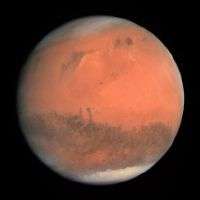
It's no secret that Mars is a beaten and battered planet -- astronomers have been peering for centuries at the violent impact craters created by cosmic buckshot pounding its surface over billions of years. But just how beat up is it?
Really beat up, according to a University of Colorado Boulder research team that recently finished counting, outlining and cataloging a staggering 635,000 impact craters on Mars that are roughly a kilometer or more in diameter.
As the largest single database ever compiled of impacts on a planet or moon in our solar system, the new information will be of help in dating the ages of particular regions of Mars, said CU-Boulder postdoctoral researcher Stuart Robbins, who led the effort. The new crater atlas also should help researchers better understand the history of water volcanism on Mars through time, as well as the planet's potential for past habitability by primitive life, he said.
"This database is a giant tool that will be helpful in scores of future Mars studies ranging from age-dating and erosion to planetary habitability and to other applications we have not even thought of yet," said Robbins, who is affiliated with CU-Boulder's Laboratory for Atmospheric and Space Physics. "In a sense it's like building a new and better hammer, which quickly becomes used by everyone."
A paper on the subject by Robbins and CU-Boulder faculty member Brian Hynek appeared last week in the Journal of Geophysical Research – Planets, a publication of the American Geophysical Union. A companion study by the two CU researchers was published in a recent issue of the same journal. The study was funded by NASA's Mars Data Analysis Program.
The assembly of the new Mars crater database was tedious, said Robbins. "We have all this new information coming from Mars orbiters and landers that have helped generate far better maps illustrating the planet's topography and surface details. I basically analyzed maps and drew crater rim circles for four years."
Hynek, a LASP research associate and assistant professor in the geological sciences department, said knowing more about the history and extent of Martian cratering has implications for better understanding the potential for past life on Mars.
"Many of the large impact craters generated hydrothermal systems that could have created unique, locally habitable environments that lasted for thousands or millions of years, assuming there was water in the planet's crust at the time," said Hynek. "But large impacts also have the ability to wipe out life forms, as evident from Earth's dinosaur-killing Chicxulub impact 65 million years ago."
Robbins said most of the smaller diameter craters on Mars are younger than the largest craters and form the bulk of the planet's crater population. "The basic idea of age dating is that if a portion of the planet's surface has more craters, it has been around longer," said Robbins. Much of the planet has been "resurfaced" by volcanic and erosional activity, essentially erasing older geological features, including craters.
The new database also is expected to help planetary scientists better understand erosion on the planet, said Robbins, who earned his doctoral degree from CU-Boulder's astrophysical and planetary sciences department. "Our crater database contains both rim heights and crater depths, which can help us differentiate between craters that have been filled in versus those that have eroded by different processes over time, giving us a better idea about long-term changes on the planet's surface."
Having a better handle on the size and distribution of Martian impact craters also has implications for future, manned missions to the planet, said Hynek. NASA wants to know where the craters are and their particular features both from a safety and research standpoint. "Craters act as a 'poor man's drill' that provide new information about the subsurface of Mars," he said.
Since the most complete databases of lunar craters include only those roughly 10 to 15 kilometers in diameter or larger, and databases on Mercury's craters contain only those over roughly 20 kilometers in diameter, it is difficult to compare them with the Martian crater database, said Robbins. While there are only about 150 to 200 known impact craters left on Earth, both the moon and Mercury are still peppered with craters due to their lack of atmosphere and plate tectonic activity, he said.
Cataloging the cratering of Mars and the moon is helping scientists understand a time a few hundred million years after the inner solar system formed, including an event about 3.9 billion years ago known as the "Late Heavy Bombardment" in which asteroids as large as Kansas rained down on Earth. "Although Earth has lost most of its geologic record due to tectonic plate movements and erosion, understanding the impact crater history on the moon and Mars can help us reconstruct our early days," said Hynek.
Provided by University of Colorado at Boulder


