Hubble spots a bright spark in a nearby spiral galaxy
Jun 11, 2012
Credit: ESA/Hubble & NASA. Acknowledgement: Matej Novak

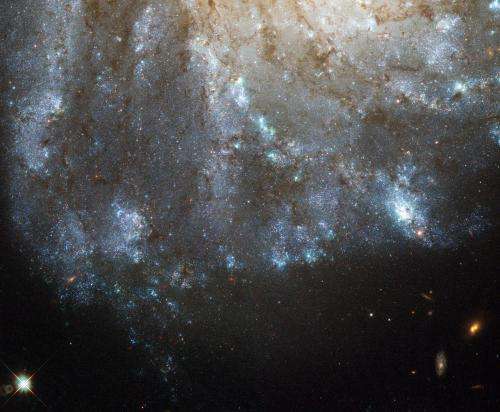
(Phys.org) -- This image, taken by the NASA/ESA Hubble Space Telescope, shows a detailed view of the spiral arms on one side of the galaxy Messier 99. Messier 99 is a so-called grand design spiral, with long, large and clearly defined spiral arms — giving it a structure somewhat similar to the Milky Way.

Lying around 50 million light-years away, Messier 99 is one of over a thousand galaxies that make up the Virgo Cluster, the closest cluster of galaxies to us. Messier 99 itself is relatively bright and large, meaning it was one of the first to be discovered, way back in the 18th century. This earned it a place in Charles Messier’s famous catalog of astronomical objects.

In recent years, a number of unexplained phenomena in Messier 99 have been studied by astronomers. Among these is the nature of one of the brighter stars visible in this image. Cataloged as PTF 10fqs, and visible as a yellow-orange star in the top-left corner of this image, it was first spotted by the Palomar Transient Facility, which scans the skies for sudden changes in brightness (or transient phenomena, to use astronomers’ jargon). These can be caused by different kinds of event, including variable stars and supernova explosions.

What is unusual about PTF 10fqs is that it has so far defied classification: it is brighter than a nova (a bright eruption on a star’s surface), but fainter than a supernova (the explosion that marks the end of life for a large star). Scientists have offered a number of possible explanations, including the intriguing suggestion that it could have been caused by a giant planet plunging into its parent star.

This Hubble image was made in June 2010, during the period when the outburst was fading, so PTF 10fqs’s location could be pinpointed with great precision. These measurements will allow other telescopes to home in on the star in future, even when the afterglow of the outburst has faded to nothing.

A version of this image of Messier 99 was entered into the Hubble’s Hidden Treasures Competition by contestant Matej Novak. Hidden Treasures is an initiative to invite astronomy enthusiasts to search the Hubble archive for stunning images that have never been seen by the general public. The competition is now closed and the winners will be announced soon.

Explore further: Hubble reveals the ring nebula's true shape

Related Stories

Glittering jewels of Messier 9

Mar 16, 2012

(PhysOrg.com) -- The NASA/ESA Hubble Space Telescope has produced the most detailed image so far of Messier 9, a globular star cluster located close to the center of the galaxy. This ball of stars is too faint ...

Hubble snaps heavyweight of the Leo Triplet

Apr 08, 2010

Hubble has snapped a spectacular view of the largest "player" in the Leo Triplet, a galaxy with an unusual anatomy: it displays asymmetric spiral arms and an apparently displaced core. The peculiar anatomy ...

A spiral in Leo

Aug 10, 2011

(PhysOrg.com) -- This new picture from ESO’s Very Large Telescope shows NGC 3521, a spiral galaxy located about 35 million light years away in the constellation of Leo (The Lion). Spanning about 50 000 ...

Image: Hubble peeks inside a stellar cloud

Apr 23, 2012

(Phys.org) -- These bright stars shining through what looks like a haze in the night sky are part of a young stellar grouping in one of the largest known star formation regions of the Large Magellanic Cloud ...

Hubble spies edge-on beauty

May 21, 2012

(Phys.org) -- Visible in the constellation of Andromeda, NGC 891 is located approximately 30 million light-years away from Earth. The NASA/ESA Hubble Space Telescope turned its powerful wide field Advanced ...

Hubble sees Messier 70: Tight and bright

Apr 13, 2012

(Phys.org) -- In this image, the NASA/ESA Hubble Space Telescope has captured the brilliance of the compact center of Messier 70, a globular cluster. Quarters are always tight in globular clusters, where the ...

Recommended for you

Hubble reveals the ring nebula's true shape

11 hours ago

(Phys.org) —The Ring Nebula's distinctive shape makes it a popular illustration for astronomy books. But new observations by NASA's Hubble Space Telescope of the glowing gas shroud around an old, dying, ...

A hidden population of exotic neutron stars

16 hours ago

(Phys.org) —Magnetars – the dense remains of dead stars that erupt sporadically with bursts of high-energy radiation - are some of the most extreme objects known in the Universe. A major campaign using ...

Very Large Telescope celebrates 15 years of success

21 hours ago

(Phys.org) —With this new view of a spectacular stellar nursery ESO is celebrating 15 years of the Very Large Telescope—the world's most advanced optical instrument. This picture reveals thick clumps ...

Fragile mega-galaxy is missing link in history of cosmos

May 22, 2013

Two hungry young galaxies that collided 11 billion years ago are rapidly forming a massive galaxy about 10 times the size of the Milky Way, according to UC Irvine-led research published Wednesday in the journal ...

User comments : 0

More news stories

A hidden population of exotic neutron stars

(Phys.org) —Magnetars – the dense remains of dead stars that erupt sporadically with bursts of high-energy radiation - are some of the most extreme objects known in the Universe. A major campaign using ...

Hubble reveals the ring nebula's true shape

(Phys.org) —The Ring Nebula's distinctive shape makes it a popular illustration for astronomy books. But new observations by NASA's Hubble Space Telescope of the glowing gas shroud around an old, dying, ...

Century-old science helps confirm global warming

(Phys.org) —Ocean measurements taken more than 135 years ago during the scientific expedition of HMS Challenger have provided further confirmation of human-produced global warming over the past century.

Controlling mood through the motions of mitochondria

(Medical Xpress)—Regulating the distribution of power in neurons is done by a system that makes the national electric grid look simple by comparison. Each neuron has several thousand mitochondria confined ...

A quantum simulator for magnetic materials

Physicists understand perfectly well why a fridge magnet sticks to certain metallic surfaces. But there are more exotic forms of magnetism whose properties remain unclear, despite decades of intense research. ...