Increasing levels of carbon dioxide in Arctic coastal seas
Jun 18, 2012
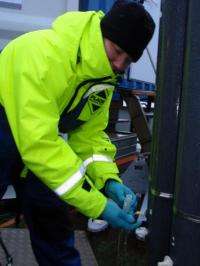
Iréne Wľhlström has investigated two of the coastal seas off Siberia, the Laptev Sea and the East Siberian Sea, in a ship-borne expedition, and -- in the case of the Laptev Sea -- by mathematical modelling. Credit: Photo: University of Gothenburg

The Arctic coastal seas absorb the greenhouse gas carbon dioxide to an ever-decreasing extent. This leads to an increase in the level in the atmosphere and an increase in the rate of warming in the Arctic. This is the conclusion from research carried out at the University of Gothenburg, Sweden.

Most scientists consider that changes to the Earth's climate are caused by increasing amounts of greenhouse gases released by humans from, for example, the combustion of fossil fuels. plays a major role in this process.

The oceans absorb carbon dioxide

Approximately half of the emission of carbon dioxide from human combustion of fossil fuels was absorbed by the oceans up until 1994. As the amount of carbon dioxide in the oceans rises, however, their capacity to absorb the gas falls, and it remains in the .

"The greenhouse gases raise the temperature of the and this increase is particularly noticeable in the Arctic. It is even more pronounced in Siberia and its coastal seas," says Iréne Wåhlström, researcher in marine chemistry.

The increase in temperature has an impact on the environment in the Arctic – the cover of sea ice is lower, for example, and the supply of water from rivers increases, the permafrost thaws and the rate of coastal erosion increases.

"One consequence is that organic matter that has been stored in soil is carried to the seas, where it is partially broken down to carbon dioxide," says Iréne Wåhlström.

Climate change affects the carbon dioxide system

Iréne Wåhlström has investigated two of the coastal seas off , the Laptev Sea and the East Siberian Sea, in a ship-borne expedition, and – in the case of the Laptev Sea – by mathematical modelling.

The East Siberian Sea has a western part and an eastern part, into which water flows from the Pacific .

"The level of marine photosynthesis is high in these waters during the summer, and carbon dioxide is consumed. This leads to the level in the sea being lower than in the air, and the sea absorbs carbon dioxide from the air," says Iréne Wåhlström.

The western East Siberian Sea receives also a major contribution from rivers, both directly from the land and from the neighbouring Laptev Sea.

"The river water contains high levels of organic matter, which is partially broken down to carbon dioxide in the sea. This leads to the level in the sea being higher than in the air, and thus carbon dioxide flows from the sea into the air, accelerating change."

The Laptev Sea had an excess of carbon dioxide during the late summer of 2008 that was of the same order of magnitude as the western East Siberian Sea, probably caused by the breakdown of organic matter from the land.

The results suggest that the Laptev Sea has changed from being a sink for atmospheric carbon dioxide to become a source of carbon dioxide during the late summer. This will probably be reinforced by a higher air temperature, particularly if parts of the large reservoir of stored organic matter in the Arctic tundra thaw and are carried to the sea. This will further increase the rate of temperature rise of the Earth.

Explore further: Sea level influenced tropical climate during the last ice age

add to favorites email to friend print save as pdf

Related Stories

North Sea efficient sink for carbon dioxide

Oct 10, 2005

A relatively large number of algae grow in the North Sea. These form the basis for a much richer food chain than that found in the Atlantic Ocean. Dutch-sponsored researcher Yann Bozec calculated that coastal seas such as ...

Food source threatened by carbon dioxide

Dec 10, 2007

Carbon dioxide increasing in the atmosphere may affect the microbial life in the sea, which could have an impact on a major food source, warned Dr Ian Joint at a Science Media Centre press briefing today.

Recommended for you

Alaska volcano shoots ash 15,000 feet into the air

May 18, 2013

(AP)—One of Alaska's most restless volcanoes has shot an ash cloud 15,000 feet into the air in an ongoing eruption that has drawn attention from a nearby community but isn't expected to threaten air traffic.

NASA sees Cyclone Mahasen hit Bangladesh

May 17, 2013

NASA's Tropical Rainfall Measuring Mission satellite known as TRMM measured Cyclone Mahasen's rainfall rates from space as it made landfall on May 16. Mahasen has since dissipated over eastern India.

Rapid climate change ruled out ice age trees

May 17, 2013

Short, sharp fluctuations in the Earth's climate throughout the last ice age may have stopped trees from getting a foothold in Europe and northern Asia, scientists say.

User comments : 1

Adjust slider to filter visible comments by rank

Display comments: newest first

deatopmg
5 / 5 (1) Jun 18, 2012
After all these years there is still NO hard evidence, i.e. raw, unadjusted data, that show so called greenhouse gasses cause an increase in Earths temperature. It's still only a supposition.

Correlation does not mean causation, e.g. the incidence of heart disease correlates well with the increase in CO2 concentration during the 20th century - is that the cause? or is it heart disease and temperature?

Not mentioned here is the potential (alarming) decrease in pH due to greater CO2 solubility. The tiny change is probably too difficult to measure accurately though.

More news stories

Mice, gerbils perish in Russia space flight

A number of mice and eight gerbils sent into space in a Russian capsule destined to find out how well organisms can withstand extended flights perished during their journey, scientists said Sunday as the ...

Heat-related deaths in Manhattan projected to rise

Residents of Manhattan will not just sweat harder from rising temperatures in the future, says a new study; many may die. Researchers say deaths linked to warming climate may rise some 20 percent by the 2020s, ...

Honeybees trained in Croatia to find land mines

(AP)—Mirjana Filipovic is still haunted by the land mine blast that killed her boyfriend and blew off her left leg while on a fishing trip nearly a decade ago. It happened in a field that was supposedly ...

Bold action, big money needed to curb Asia floods

Asia's flood-prone megacities should fund major drainage, water recycling and waste reduction projects to stem deluges and secure clean supply for their booming populations, experts said Sunday.