Treating poultry diseases without antibiotics
May 30, 2012 By Sandra Avant
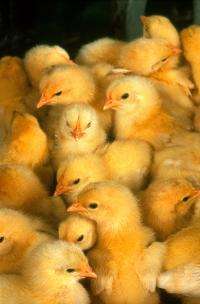
ARS scientists are finding proteins in chickens that can act as alternatives to antibiotics to control infectious diseases such as coccidiosis and Clostridium in poultry. Credit: Keith Weller

Identifying antimicrobial proteins in chickens that kill pathogens is one method being used by U.S. Department of Agriculture (USDA) scientists to find alternatives to the use of antibiotics to control infectious poultry diseases.

Each year, poultry diseases such as coccidiosis cause losses of more than $600 million in the United States and $3.2 billion worldwide.

Hyun Lillehoj, at the Agricultural Research Service (ARS) Henry A. Wallace Beltsville Agricultural Research Center (BARC) in Beltsville, Md., has dedicated her career to discovering how to produce poultry without using drugs. Her research includes enhancing innate immunity through genetics, and examining molecules produced by birds in response to enteric or intestinal pathogens.

ARS is USDA's chief intramural scientific research agency, and this research supports USDA's priority of promoting international food security.

Some molecules are host antimicrobial proteins that can kill pathogens, improve immune responses and promote the growth of beneficial gut bacterial populations in poultry, according to Lillehoj, who works in the ARS Animal Laboratory at BARC. She and her colleagues have identified one such immune molecule, called NK lysin.

Lillehoj and her colleagues demonstrated for the first time that NK lysin kills chicken coccidia. They also showed that this antimicrobial protein or host defense molecule is effective against other parasites such as Neospora and Cryptosporidia, which infect livestock and humans, respectively. One commercial company is looking at the possibility of developing NK lysin into a product that can be used to kill chicken .

Lillehoj also is studying enteric bacterial infections caused by Clostridium, a pathogen associated with in poultry. She is using a similar to develop alternatives to treat this disease.

Working with industry, international partners and other scientists, Lillehoj has discovered other options to antibiotic use in poultry. Phytochemicals derived from peppers, plums, safflower, green tea and other plants have been shown to be effective in enhancing the immune system of chickens. Also, the beneficial effects of probiotics, which are live, nonpathogenic bacteria that promote health and balance of the intestinal tract microbiota, have been demonstrated in past research.

Explore further: Going green: Nation equipped to grow serious amounts of pond scum for fuel

More information: Read more about this research in the May/June 2012 issue of Agricultural Research magazine.

add to favorites email to friend print save as pdf

Related Stories

New technique used to discover new viruses in poultry

May 18, 2012

In a search to find better ways to control viral enteric diseases in birds, U.S. Department of Agriculture (USDA) scientists have unearthed a treasure trove of previously known and unknown viruses in poultry ...

New cause identified for necrotic enteritis in chicken

Feb 08, 2008

Researchers from Monash University and CSIRO Livestock Industries have demonstrated for the first time that alpha-toxin protein, long thought to be required for necrotic enteritis to develop, is not the main cause of the ...

Tyson to change 'no antibiotic' labels

Dec 21, 2007

Tyson Foods said it has reached an agreement with the U.S. Department of Agriculture in a dispute over the labeling of poultry products.

Newcastle disease gets new vaccine

Jan 14, 2011

A new vaccine for Newcastle disease (ND) in poultry has been developed by U.S. Department of Agriculture (USDA) scientists in Athens, Ga. Using reverse genetics technology, the new vaccine is made from part ...

Recommended for you

'Whodunnit' of Irish potato famine solved

May 21, 2013

An international team of scientists reveals that a unique strain of potato blight they call HERB-1 triggered the Irish potato famine of the mid-19th century.

Engineered microbes grow in the dark

May 20, 2013

Scientists at the University of California, Davis have engineered a strain of photosynthetic cyanobacteria to grow without the need for light. They report their findings today at the 113th General Meeting of the American ...

User comments : 0

More news stories

Single-cell sequencing

When studying any kind of population—people or cells—averaging is a useful, if flawed, form of measurement. According to the US Census Bureau, the average American household size in 2010 was 2.59. Of ...

Designer eucalypts for urban landscapes

University of Adelaide researchers are working with the Australian nursery industry to produce 'designer eucalypts' more suitable for our home gardens and urban landscapes than many trees currently available.

Australia set to cull 10,000 wild horses

A controversial cull of up to 10,000 wild horses in Australia's harsh Outback reportedly began Wednesday in a bid to control the feral animals which officials say are destroying the land.

Sony mulls hedge fund's entertainment sale idea

Sony's CEO Kazuo Hirai says the electronics giant's board will discuss a proposal by U.S. hedge fund manager Daniel Loeb to spin off up to 20 percent of its movie, TV and music division.

Italy approves law on controversial stem cell therapy

Italian lawmakers on Wednesday gave their final approval to a law that allows limited use of a controversial type of stem cell therapy which has been condemned by many scientists but has given hope to families of terminally-ill ...

Social media puts HR ethics under the spotlight

Social media has definitely changed the game for job-seekers and recruiters. Traditionally, HR recruiters placed an advertisement, sifted through the responses, and interviewed the shortlisted candidates ...