Population pressure impacts world wetlands
May 14, 2012
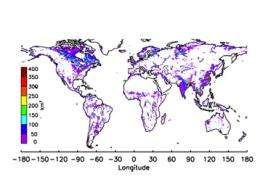
Areas of the world covered by wetlands. Data shown is the annual average for the period between 1993 and 2007, estimated from satellite data (areas are given in km2; each pixel represents 773km2). Credit: Fabrice Papa

(Phys.org) -- The area of the globe covered by wetlands (swamps, marshes, lakes, etc.) has dropped by 6% in fifteen years. This decline is particularly severe in tropical and subtropical regions, and in areas that have experienced the largest increases in population in recent decades. These are the conclusions of a study conducted by CNRS and IRD researchers from the Laboratoire d'étude du rayonnement et de la matière en astrophysique, Laboratoire d'études en géophysique et oceanography spatiales and the start-up Estellus. To obtain these results, the scientists performed the first worldwide mapping of the wetlands and their temporal dynamics, for the years 1993 to 2007. This study, which has just been published in the journal Geophysical Research Letters, emphasizes the impact of population pressure on water cycles.

Marshes, lagoons, and bogs are all types of wetlands—regions where water is the main controlling factor for the environment and its plant and animal life. Although they cover less than 5% of the Earth's land surface, these areas play a key role in human activities, biodiversity, climate and the water cycle. Indeed, they produce one third of atmospheric methane, a major greenhouse gas. Moreover, these regions impact the transfer of continental freshwater to the sea and alter local weather by enhancing evaporation.

A better understanding of wetlands, their way of functioning and their variability and dynamics over time, are essential for assessing climate change and making sound recommendations for water resource management. Characterizing wetland distribution and quantifying seasonal and inter-annual variations across the globe is, however, a huge challenge. No similar study had ever been undertaken until now, as these areas are diverse and spread across the whole planet from the tropics to the Arctic.

By combining and simultaneously analyzing a large amount of data from different satellites, the researchers succeeded in developing the first mapping of wetlands and their temporal dynamics throughout the world over fifteen years. The first conclusion from this study is that the extent of wetlands varied greatly during any year, but also from one year to another, with strong modulation during El Niño events. Moreover, between 1993 and 2007, scientists observed a 6% fall in wetland areas. This trend was particularly severe in tropical and subtropical regions. The highest declines are concentrated in the areas where the largest increases in human population have been recorded over the last two decades.

This study suggests that pressure impacts hydrological cycles at the global scale. This pressure may stem from the draining of wetlands for urban development and the increase in water extraction from .

Explore further: Review finds need for more water quality data in the Marcellus shale region

More information: Changes in land surface water dynamics since the 1990s and relation to population pressure, Prigent, C., F. Papa, et al., Geophys. Res. Lett., doi:10.1029/2012GL051276 , in press (2012).

add to favorites email to friend print save as pdf

Related Stories

Wetlands are bad and good news for Arctic warming: study

Jun 07, 2011

(PhysOrg.com) -- Seasonal wetlands in Arctic regions will initially persist longer due to global warming but then shrink as temperatures rise further, according to new study into how climate change will progress this century.

Flooding might help lower gas emission from wetlands

Sep 23, 2008

River floods and storms that send water surging through swamps and marshes near rivers and coastal areas might cut in half the average greenhouse gas emissions from those affected wetlands, according to recent research at ...

Report: Net increase in U.S. wetlands

Mar 31, 2006

Interior Secretary Gale A. Norton and Agriculture Secretary Mike Johanns said for the first time since 1954, there is a net increase in U.S. wetlands.

Tibet wetlands being protected

Feb 13, 2006

Tibet's wetlands are being protected from drying up, and leading the country in vegetation acreage, Chinese officials said.

Beaver population helps battle drought

Feb 20, 2008

They may be considered pests, but beaver can help mitigate the effects of drought, and because of that, their removal from wetlands to accommodate industrial, urban and agricultural demands should be avoided, ...

Recommended for you

Climate change and wildfire: Synthesis of recent findings

8 hours ago

Concerns continue to grow about the effects of climate change on fire. Wildfires are expected to increase 50 percent across the United States under a changing climate, over 100 percent in areas of the West by 2050 as projected ...

Moore tornado a rarity, experts say

10 hours ago

Tornados, among the most violent of atmospheric storms, rarely reach the size and brutality of the twister that swept through an Oklahoma City suburb on Monday, experts say.

NGOs denounce Malaysia hydropower meeting

13 hours ago

Three dozen Malaysian NGOs on Tuesday denounced the world hydroelectric industry's decision to hold a conference in a Borneo state where dam projects have uprooted forests and native peoples.

User comments : 0

More news stories

Power of US tornado dwarfs Hiroshima bomb

Wind, humidity and rainfall combined precisely to create Monday's massive killer tornado in Oklahoma. The awesome amount of energy released dwarfed the power of the atomic bomb that leveled Hiroshima.

Encouraging signs for bee biodiversity

Declines in the biodiversity of pollinating insects and wild plants have slowed in recent years, according to a new study. Researchers led by the University of Leeds and the Naturalis Biodiversity Centre in the Netherlands ...

If you can remember it, you can remember it wrong

(Medical Xpress)—Native peoples in regions where cameras are uncommon sometimes react with caution when their picture is taken. The fear that something must have been stolen from them to create the photo ...

B vitamins could delay dementia

(Medical Xpress)—Despite spending billions of dollars on research and development, drug companies have been unable to come up with effective treatments for dementia and Alzheimer's Disease (AD). Now, A. ...

New method for producing clean hydrogen

Duke University engineers have developed a novel method for producing clean hydrogen, which could prove essential to weaning society off of fossil fuels and their environmental implications.