Nuisance seaweed found to produce compounds with biomedical potential
May 24, 2012
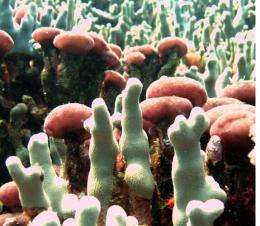
Cyanobacteria (dark shades) found in Hawaii produce chemical compounds with biomedical potential. Photo credit: Jennifer Smith

A seaweed considered a threat to the healthy growth of coral reefs in Hawaii may possess the ability to produce substances that could one day treat human diseases, a new study led by scientists at Scripps Institution of Oceanography at UC San Diego has revealed.

An analysis led by Hyukjae Choi, a postdoctoral researcher in William Gerwick's laboratory at Scripps, has shown that the , a tiny known as a "cyanobacterium," produces that exhibit promise as anti-inflammatory agents and in combatting bacterial infections. The study is published in the May 25th issue of the journal Chemistry & Biology.

"In different arenas these compounds could be helpful, such as treating chronic inflammatory conditions for which we currently don't have really good medicines," said Gerwick, a professor of oceanography and pharmaceutical sciences at the Center for Marine Biotechnology and Biomedicine at Scripps and UC San Diego Skaggs School of Pharmacy and Pharmaceutical Sciences.

Scientists identified the "nuisance" organism in 2008 on the reefs directly adjacent to the National Park Pu'uhonua o H'onaunau off the Kona coast of . The cyanobacterium is believed to be native to Hawaii and is usually inconspicuous, said Jennifer Smith, a Scripps assistant professor in the Scripps Center for Marine Biodiversity and Conservation and a paper coauthor.

"When we first found the bloom during routine surveys with the University of Hawaii we were concerned as it was clearly smothering the corals at one of the most popular dive sites in Hawaii," said Smith. "Observations in the field even suggested that the cyanobacteria may have been releasing some chemical that was causing the coral to bleach."

When Smith and her colleagues found the seaweed blooming it was clear that it was overgrowing and negatively affecting the underlying corals. Samples were retrieved in 2009 and transferred to Scripps for analysis.

Choi, Gerwick and their colleagues conducted various laboratory experiments and discovered that the seaweed (the Leptolyngbya crossbyana) generates natural products known as honaucins with potent anti-inflammation and bacteria-controlling properties.

Specifically, the substances hamper bacteria's ability to "swarm" over surfaces. For example, when overtaking a new area, bacteria secrete small amounts of a substance known as a quorum sensing factor, which tests to see if the new surface is safe for colonization. Halting a quorum sensing factor could one day translate to a treatment for bacterial infections. For instance, this could be critical, Gerwick said, in the development of drugs to prevent infection in patients who require catheters to deliver vital nutrients to key areas such as arteries, as well the development of new treatments for acne and other skin conditions.

"I think this finding is a nice illustration of how we need to look more deeply in our environment because even nuisance pests, as it turns out, are not just pests," said Gerwick. "It's a long road to go from this early-stage discovery to application in the clinic but it's the only road if we want new and more efficacious medicines."

"These organisms have been on the planet for millions of years and so it is not surprising that they have evolved numerous strategies for competing with neighboring species, including chemical warfare," said Smith. "Several species of cyanobacteria and algae are known to produce novel compounds, many that have promising use in drug development for human and other uses."

Explore further: Protein study suggests drug side effects are inevitable

Related Stories

Researchers decode structure of promising sea compound

Aug 28, 2009

Scientists at Scripps Institution of Oceanography at UC San Diego and their colleagues at Creighton University have deciphered the highly unusual molecular structure of a naturally produced, ocean-based compound ...

Genome of marine organism reveals hidden secrets

May 09, 2011

An international team of researchers led by scientists at Scripps Institution of Oceanography at UC San Diego has deciphered the genome of a tropical marine organism known to produce substances potentially ...

Researchers identify novel anticancer drug from the sea

Feb 11, 2008

A collaborative team of researchers spearheaded by Dennis Carson M.D., professor of medicine and director of the Rebecca and John Moores UCSD Cancer Center at the University of California, San Diego (UCSD) ...

Recommended for you

Protein study suggests drug side effects are inevitable

11 hours ago

A new study of both computer-created and natural proteins suggests that the number of unique pockets – sites where small molecule pharmaceutical compounds can bind to proteins – is surprisingly small, meaning drug side ...

Attacking MRSA with metals from antibacterial clays

May 17, 2013

In the race to protect society from infectious microbes, the bugs are outrunning us. The need for new therapeutic agents is acute, given the emergence of novel pathogens as well as old foes bearing heightened antibiotic resistance.

Keeping fruit, vegetables and cut flowers fresh longer

May 15, 2013

New technology offers the promise of reducing billions of dollars of losses that occur each year from the silent, invisible killer of fruits, vegetables and cut flowers—a gas whose effects are familiar to everyone who has ...

Why don't beetles freeze in the winter?

May 14, 2013

For 37 years, Queen's University Biochemistry professor Peter Davies has been unraveling the mystery of why some organisms including insects and fish don't freeze in the winter. His research into insect antifreeze protein ...

User comments : 1

Adjust slider to filter visible comments by rank

Display comments: newest first

PPihkala
not rated yet May 24, 2012
I think quorum sensing disruption has been elsewhere indicated to be safe consistent way to fight microbes. They are also less prone to develop resistance like they do to antibiotics.

More news stories

Protein study suggests drug side effects are inevitable

A new study of both computer-created and natural proteins suggests that the number of unique pockets – sites where small molecule pharmaceutical compounds can bind to proteins – is surprisingly small, meaning drug side ...

Non-wetting fabric drains sweat

(Phys.org) —Waterproof fabrics that whisk away sweat could be the latest application of microfluidic technology developed by bioengineers at the University of California, Davis.

Beautiful 'flowers' self-assemble in a beaker

By simply manipulating chemical gradients in a beaker of fluid, materials scientists at Harvard have found that they can control the growth behavior of crystals to create precisely tailored structures—such ...

Attacking MRSA with metals from antibacterial clays

In the race to protect society from infectious microbes, the bugs are outrunning us. The need for new therapeutic agents is acute, given the emergence of novel pathogens as well as old foes bearing heightened antibiotic resistance.

New immune system discovered

(Medical Xpress)—A research team, led by Jeremy Barr, a biology post-doctoral fellow, unveils a new immune system that protects humans and animals from infection.

Lab sets a new record for creating heralded photons

(Phys.org) —Entanglement, by general consensus of physicists, is the weirdest part of quantum science. To say that two particles, A and B, are entangled means that they are actually two parts of an inseparable ...