Parts of Mt Fuji 'could collapse' if fault shifts
May 11, 2012
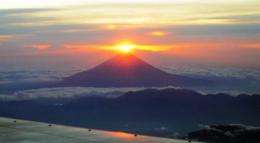
The sun rises behind Japan's Mount Fuji. Parts of Mount Fuji, a national symbol and key tourist attraction, could collapse if a newly-discovered faultline under the mountain shifts, a government-commissioned report has warned.

Parts of Japan's Mount Fuji, a national symbol and key tourist attraction, could collapse if a newly-discovered faultline under the mountain shifts, a government-commissioned report has warned.

A three-year study by seismologists discovered a previously unknown active fault underneath the mountain, which sits around 100 kilometres (60 miles) west of Tokyo.

"It's possible that (parts of) the mountain could collapse with mudslides flowing to Gotemba," a city between the mountain and the Pacific, said Yasuhiro Yoshida, director for earthquake investigation at the science ministry.

A team of researchers, led by academics from the University of Tokyo, fired simulated seismic waves at the mountain, which revealed a fault that was theoretically capable of generating an earthquake of up to magnitude seven.

The team said they believed the fault moved some time in the last million years, although it was not clear when.

Yoshida said local geography showed Mount Fuji experienced major mudslides nearly 3,000 years ago, but that more studies are required to determine how the fault could affect potential , and vice versa.

The area around the mountain, an almost perfect that is much admired for its beauty, is known for having frequent earthquakes and numerous , even for quake-prone Japan.

Japan has been on heightened alert for possible quakes and other natural hazards since the 9.0 magnitude quake and the tsunami of March 2011 killed 19,000 people and sparked a at Fukushima.

Explore further: Astonishing hi-resolution satellite views of the destruction from the Moore, Oklahoma tornado

add to favorites email to friend print save as pdf

Related Stories

Tokyo quake fault line is re-evaluated

Jul 15, 2005

A new survey suggests the fault line beneath Tokyo is miles closer to the surface than seismologists realized, Nature.com reported Thursday.

Biggest recorded earthquake was brewing for four centuries

Oct 07, 2005

The earthquake that rocked Chile in 1960 - at magnitude 9.5, the biggest ever recorded - was preceded by almost 400 years of accumulating stress, according to studies of the region's buried soils and sand. Strain had been ...

No long-distance risks from mega-quakes: study

Mar 27, 2011

Monster earthquakes like the 9.0-magnitude event that occurred off Japan on March 11 are unlikely to trigger a large quake in distant regions of the world, according to a study published on Sunday.

Turkey, a country at seismic crossroads

Oct 24, 2011

The 7.2-magnitude earthquake that struck Van province in eastern Turkey on Sunday, causing hundreds of fatalities, underscores the country's fate to be straddling one of the world's most active seismic zones.

Recommended for you

Strong earthquake at exceptional depth

May 24, 2013

This morning at 05:45 CEST, the earth trembled beneath the Okhotsk Sea in the Pacific Northwest. The quake, with a magnitude of 8.2, took place at an exceptional depth of 605 kilometers. Because of the great ...

Marine forecasting on the horizon for Indian Ocean Rim

May 24, 2013

Nearly all of the member countries of the Indian Ocean Rim Association for Regional Cooperation (IOR-ARC) will attend the week-long workshop to further cooperation and understanding on international ocean ...

Russia evacuates drifting Arctic research station

May 23, 2013

Russia has ordered the urgent evacuation of the 16-strong crew of a drifting Arctic research station after ice floe that hosts the floating laboratory began to disintegrate, officials said Thursday.

User comments : 0

More news stories

Galaxies fed by funnels of fuel

(Phys.org) —Computer simulations of galaxies growing over billions of years have revealed a likely scenario for how they feed: a cosmic version of swirly straws.

Century-old science helps confirm global warming

(Phys.org) —Ocean measurements taken more than 135 years ago during the scientific expedition of HMS Challenger have provided further confirmation of human-produced global warming over the past century.