New, inexpensive paper-based diabetes test ideal for developing countries
With epidemics of Type 2 diabetes looming in rural India, China and other areas of the world where poverty limits the availability of health care, scientists are reporting development of an inexpensive and easy-to-use urine test ideally suited for such areas. The report describing the paper-based device, which also could be adapted for the diagnosis and monitoring of other conditions and the environment, appears in ACS' journal Analytical Chemistry.
Jan Lankelma and colleagues point out that monitoring glucose levels is important. Although diabetes test strips seem inexpensive, the cost can be prohibitive in areas where people must choose between that and the essentials of life, such as food and shelter. In addition, current handheld diabetes monitoring devices measure glucose levels in blood, which requires a pin-prick to a finger — something that could deter patients from taking the measurements. To address these challenges, the researchers built a new type of glucose monitor — one that detects glucose levels in urine (which is easy to obtain) and is made from inexpensive materials, such as paper.
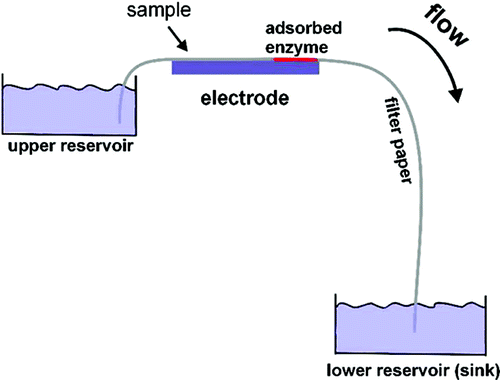
The device consists of three electrodes, a buffer solution, a piece of paper (or nitrocellulose) and a plastic dish. The sample is injected onto the paper with a slightly modified medical syringe, and the solution moves along the paper by gravity and capillary action. An enzyme called glucose oxidase is already on the paper, and it reacts with glucose in the sample to produce hydrogen peroxide, which is detected by the electrodes. The system can be built quickly, is inexpensive and produces results similar to those from a more expensive, commercially available clinical instrument. The authors state that the device could be used not only in a clinical lab, but it could also be further developed for applications as diverse as analyzing food quality and environmental monitoring.
More information: Paper-Based Analytical Device for Electrochemical Flow-Injection Analysis of Glucose in Urine, Anal. Chem., 2012, 84 (9), pp 4147–4152. DOI: 10.1021/ac3003648
Abstract
This article describes a new design for a paper-based electrochemical system for flow-injection analysis. Capillary wicking facilitates a gravity-driven flow of buffer solution continuously through paper and nitrocellulose, from a buffer reservoir at one end of the device to a sink at the other. A difference in height between the reservoir and the sink leads to a continuous and constant flow. The nitrocellulose lies horizontally on a working electrode, which consists of a thin platinum layer deposited on a solid support. The counter and reference electrodes are strategically positioned upstream in the buffer reservoir. A simple pipetting device was developed for reliable application of (sub)microliter volumes of sample without the need of commercial micropipets; this device did not damage the nitrocellulose membrane. Demonstration of the system for the determination of the concentration of glucose in urine resulted in a noninvasive, quantitative assay that could be used for diagnosis and monitoring of diabetes. This method does not require disposable test strips, with enzyme and electrodes, that are thrown away after each measurement. Because of its low cost, this system could be used in medical environments that are resource-limited.
Journal information: Analytical Chemistry
Provided by American Chemical Society


