The great exoplanet debate
May 14, 2012
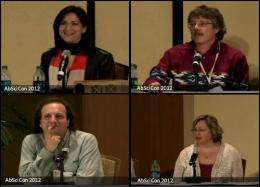
Participants included (clockwise from top left): Sara Seager, Dirk Schulze-Makuch of, Vikki Meadows, and Eric Ford. Credit: AbSciCon 2012, GATech, NASA

The Great Exoplanet Debate, hosted by Astrobiology Magazine during the recent 2012 Astrobiology Science Conference, is now available for viewing online.

Astrobiology Magazine recently hosted a Great Exoplanet Debate during the 2012 Astrobiology Science Conference (AbSciCon 2012) in Atlanta, Georgia. The panelists were David Grinspoon of the Denver Museum if Nature & Science, Sara Seager of the Massachusetts Institute of Technology, Dirk Schulze-Makuch of Washington State University, Vikki Meadows of the University of Washington, and Eric Ford of the University of Florida. Click here to watch a video of the entire debate.

The panel of experts discussed questions such as: What should the priorities be in the search for in the galaxy? How accurate can we be in identifying , Earth-like worlds around distant stars using current technology? Rather than focusing solely on Earth-like planets, should the discussion be expanded to ask where we can find habitable planets? The Decadal Survey's recommendations for planetary missions upset many, but can the astrobiology community come to an agreement about what our priorities should be in the next decade to find and characterize habitable planets? What is the future of our search for habitable, alien worlds in light of current budget restraints and mission planning?

The Astrobiology Science 2012 (AbSciCon 2012) was held April 16–20 at the Georgia Tech Hotel and Conference Center in Atlanta, Georgia, USA. The conference was sponsored by National Aeronautics and Space Administration's Program and hosted by the Georgia Institute of Technology's Ribo Evo, Center for Ribosomal Origins and Evolution. The co-Chairs of AbSciCon 2012 were Loren Williams and Eric Gaucher, both of the Georgia Institute of Technology.

Explore further: First Gagarin film turns Soviet idol into new Russian hero

add to favorites email to friend print save as pdf

Related Stories

NASA Selects Science Teams for Astrobiology Institute

Oct 03, 2008

(PhysOrg.com) -- NASA has awarded five-year grants, averaging $7 million each, to 10 research teams from across the country, including two from NASA's Jet Propulsion Laboratory in Pasadena, to study the origins, ...

Kepler space telescope mission extension proposal

Nov 03, 2011

Some potentially good news for exoplanet fans, and Kepler fans in particular – Kepler scientists are asking for a mission extension and seem reasonably confident they will get it. Otherwise, funding is ...

Habitable planets and white dwarfs

Mar 22, 2011

(PhysOrg.com) -- The search for habitable planets similar to Earth has routinely focused around active nuclear burning stars. However, in a recently published paper by Eric Agol from the University of Washington, ...

Image: The Milky Way's 100 billion planets

Apr 26, 2012

(Phys.org) -- This artist's illustration gives an impression of how common planets are around the stars in the Milky Way. The planets, their orbits and their host stars are all vastly magnified compared to ...

Recommended for you

Super-hurricane-force winds on Venus are getting stronger

17 hours ago

(Phys.org) —As the closest planet to Earth, Venus is a relatively easy object to observe. However, many mysteries remain, not least the super-rotation of Venus' atmosphere, which enables high altitude winds ...

ExoMars 2016 set to complete construction

21 hours ago

ESA's mission to Mars in 2016 has entered the final stage of construction with the signature of a contract today with Thales Alenia Space at the Paris Air & Space Show.

Australian team maps Moon's hidden craters

Jun 18, 2013

Australian scientists Tuesday said they had identified a possible 280 additional craters on the Moon, a finding they said could shed light on the history of the Earth's natural satellite.

User comments : 0

More news stories

Dish won't submit revised bid for Sprint

Satellite TV operator Dish Network Corp. said Tuesday it would not submit a revised bid for Sprint, leaving the path open for the wireless carrier to accept what it already considers a superior offer from Japan's Softbank.

Cape Wind gets $200M investment from Danish fund

The Cape Wind offshore wind project has secured a $200 million investment from a Danish pension fund in what the wind farm's president said Tuesday is a milestone for the long-delayed project.