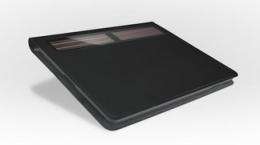
Graetzel cells are implanted in an iPad keyboard
May 29, 2012 By Nicolas Guérin
Credit: Logitech

Dye-sensitized solar cells (DSSC) from EPFL enter the public market. Logitech chose this technology to power its new flagship product.

The technological choice of this world leader demonstrates both the maturity of this invention and that it is market-ready. After several years developing its industrial application, these particularly innovated solar cells can be implanted into products such as portable tablets. This marks a new stage for Michael Graetzel's discoveries at the Laboratory of and Interfaces.

Not only are the dye-sensitized solar cells relatively inexpensive, but also they are of particular interest for their finesse and efficiency: they work equally well in ambient light as in artificial light and can produce sufficient energy even without directly facing a . These characteristics make them ideal for developing essential accessories to use in current nomadic technologies.

The performance of these solar cells comes from an operating principal that mimics . The light primes and maintains the transfer of in the dye cell, producing a current. Just as with plants, this process is efficient even in a thin or transparent layer and it is therefore possible to combine the layers and insert them in small, portable products.

Explore further: Army ground combat systems adopts tool for choosing future warfighting vehicles

add to favorites email to friend print save as pdf

Related Stories

Dye-sensitized solar cells break a new record

Nov 14, 2011

(PhysOrg.com) -- Dye-sensitized Grätzel solar cells have just set a new efficiency benchmark. By changing the composition and color of the cells, an EPFL team has increased their efficiency to more than ...

Solar cells go thin and flimsy

Sep 04, 2006

The next generation of solar cells made out of plastics and microscopic crystals instead of silicon are taking shape at UQ (University of Queensland). UQ Master of Physics student Michael Deceglie is working ...

Recommended for you

Student-built innovations to help improve and save lives

May 20, 2013

Nanyang Technological University (NTU) students have developed new and practical life-saving innovations inspired from everyday problems, including improving the safety of cyclists on the roads and keeping ...

GPS solution provides 3-minute tsunami alerts

May 17, 2013

Researchers have shown that, by using global positioning systems (GPS) to measure ground deformation caused by a large underwater earthquake, they can provide accurate warning of the resulting tsunami in ...

User comments : 0

More news stories

Amazon plans greenhouse-style headquarters

US online giant Amazon has unveiled plans for a futuristic greenhouse style headquarters "where employees can work and socialize in a more natural, park-like setting."

Game system castAR debuts at Maker Faire

(Phys.org) —Two tech talents, formerly employees at video game publisher Valve, have been working on their own vision in the form of game-ready glasses. Their company, Technical Illusions, will seek to ...

NASA's BARREL mission launches 20 balloons

(Phys.org) —In Antarctica in January, 2013 – the summer at the South Pole – scientists released 20 balloons, each eight stories tall, into the air to help answer an enduring space weather question: ...