Goddard collaborates with international partners on Magnetospheric Multiscale instrument
May 01, 2012
Goddard collaborates with international partners on MMS instrument
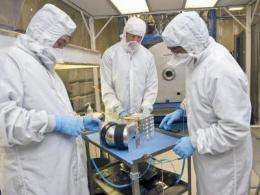
Takanobu Omoto (Meisei Lead Engineer), Mark Cox (MSFC), and Toshihiro Kobayashi (Meisei) test an MMS Dual Ion Spectrometer in the clean tent. Credit: Credit: NASA/MSFC

Whether it's a giant solar flare or a beautiful green-blue aurora, just about everything interesting in space weather happens due to a phenomenon called magnetic reconnection. Reconnection occurs when magnetic field lines cross and create a burst of energy. These bursts can be so energetic they could be measured in megatons of TNT. To study this phenomenon, NASA is readying a fleet of four identical spacecraft, the Magnetospheric Multiscale (MMS) mission, for a planned launch in 2014.

At NASA's Goddard Space Flight Center in Greenbelt, Md., a team of scientists and engineers are working on a crucial element of the MMS suite: the Fast Plasma Instrument (FPI). Some 100 times faster than any previous similar instrument, the FPI will collect a full sky map of data at the rate of 30 times per second -- a necessary speed given that MMS will only travel through the reconnection site for under a second.

"Imagine flying by a tiny object on an airplane very rapidly," says Craig Pollock, the Co-Investigator for FPI at Goddard. "You want to capture a good picture of it, but you don't get to just walk around it and take your time snapping photos from different angles. You have to grab quick shots as you're passing. That's the challenge."

FPI is being assembled at Goddard, from sub-assemblies built there, at the Southwest Research Institute in San Antonio, Texas, and at the Meisei Electric Company, Ltd. in Isasaki Japan. FPI sensors are being tested at Goddard, NASA's Marshall Space Flight Center in Huntsville, Ala., and at Japan's Institute of Space and Astronautical Science near Tokyo.

During the last week of March, 2012, researchers from all four teams came together at the Low Energy Electron and Ion Facility (LEEIF) at the National Space Science and Technology Center in Huntsville to test part of the FPI: the Dual Ion Spectrometer (DIS) flight sensors built at Mesei. The tests focused on the instrument's response when exposed to the space environment.

In the LEEIF facility, scientists and engineers expose the Dual Ion Spectrometer to ion beams of specific energy from specific directions to determine the response. This known response will be used to calibrate the flight data. Each of the MMS spacecraft will need four spectrometers, so there are 16 DIS instruments total. They will be paired with 16 Dual Electron Spectrometers (DES) and 6 Instrument Data Processing Units (IDPUs) that are being built at Goddard to complete the full FPI.

Explore further: Field tests in Mojave Desert pave way for human exploration of small bodies

add to favorites email to friend print save as pdf

Related Stories

Goddard building instrument to study reconnection

Apr 29, 2011

Whether it's a giant solar flare or a beautiful green-blue aurora, just about everything interesting in space weather happens due to a phenomenon called magnetic reconnection. Reconnection occurs when magnetic ...

NASA's Magnetospheric Mission Passes Major Milestone

Sep 06, 2010

(PhysOrg.com) -- The universe is still an arcane place that scientists know very little about, but a new NASA Solar Terrestrial Probe mission is going to shed light on one especially mysterious event called ...

Honey, I Blew up the Tokamak

Aug 31, 2009

Magnetic reconnection could be the Universe's favorite way to make things explode. It operates anywhere magnetic fields pervade space--which is to say almost everywhere. On the sun magnetic reconnection causes ...

Handover of Japan-built radar to NASA

Apr 04, 2012

On March 30, the Japan Aerospace Exploration Agency (JAXA) officially handed off a new satellite instrument to NASA at Goddard Space Flight Center, Greenbelt, Md. The Dual-frequency Precipitation Radar (DPR) ...

Recommended for you

Mars rover Opportunity examines clay clues in rock

13 hours ago

(Phys.org) —NASA's senior Mars rover, Opportunity, is driving to a new study area after a dramatic finish to 20 months on "Cape York" with examination of a rock intensely altered by water.

NASA's STEREO detects a CME from the sun

May 17, 2013

On 5:24 a.m. EDT on May 17, 2013, the sun erupted with an Earth-directed coronal mass ejection or CME, a solar phenomenon that can send billions of tons of solar particles into space that can reach Earth ...

Nine-year-old Mars rover passes 40-year-old record

May 17, 2013

While Apollo 17 astronauts Eugene Cernan and Harrison Schmitt visited Earth's moon for three days in December 1972, they drove their mission's Lunar Roving Vehicle 19.3 nautical miles (22.210 statute miles ...

Bright explosion on the Moon

May 17, 2013

For the past 8 years, NASA astronomers have been monitoring the Moon for signs of explosions caused by meteoroids hitting the lunar surface. "Lunar meteor showers" have turned out to be more common than anyone ...

User comments : 0

More news stories

Galaxy's Ring of Fire

Johnny Cash may have preferred this galaxy's burning ring of fire to the one he sang about falling into in his popular song. The "starburst ring" seen at center in red and yellow hues is not the product of ...

Alaska volcano shoots ash 15,000 feet into the air

(AP)—One of Alaska's most restless volcanoes has shot an ash cloud 15,000 feet into the air in an ongoing eruption that has drawn attention from a nearby community but isn't expected to threaten air traffic.

Chinese, Indian airlines face EU pollution fines

Eight Chinese and two Indian airlines face fines of up to several million euros for not paying for their greenhouse gas emissions during flights within the bloc, the European Commission said on Friday.

Morocco to harness the wind in energy hunt

Morocco is ploughing ahead with a programme to boost wind energy production, particularly in the southern Tarfaya region, where Africa's largest wind farm is set to open in 2014.

US seizes Bitcoin operator accounts

US authorities seized the accounts of a Bitcoin digital currency exchange operator, claiming it was functioning as an "unlicensed money service business," court documents showed Friday.