Researchers create glasses that indicate obstacles to patients with visual handicaps
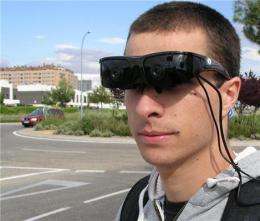
People with moderate visual impairment, particularly those who have difficulty perceiving the full extent of their surroundings, could use the ingenious device that these UC3M scientists have created. “This device is aimed at people who would bump into everything that they fail to see because of their loss of visual field, caused by glaucoma, retinal pathologies, etc.”, states the head of the project Professor Ricardo Vergaz, of UC3M’s Electronics Technology Department.
The prototype was developed using an HMD device (Head Mounted Display), a virtual reality helmet that includes two cameras to which a small computer has been attached; the computer processes all of the images that it receives. Then, thanks to an algorithm that the researchers have developed, the system determines the distance and outline of the objects and communicates the information to the user in real time using two micro screens, highlighting the silhouette of the elements in the scene and varying the colors according to their distance. “It detects objects and people who move within the visual field that a person with no visual pathologies would have. Very often the patient does not detect them due to problems of contrast”, explains Professor Vergaz. “The information regarding depth is what is most missed by patients who use this type of technical aid”, he adds.
Currently the invention is being tested using “intelligent” goggles, in collaboration with the Instituto de Oftalmología Aplicada (Institute for Applied Ophthalmology - IOBA) at the Universidad de Valladolid, where clinical tests are being carried out with a view to the device’s validation and applicability. “After testing the device on a representative sample population of patients who could use it, the IOBA will inform us of their final results at the end of this year; this will allow us to evaluate the success and validity of its performance and then improve it”, comments Ricardo Vergaz. The final objective is to improve the ergonomics of the device so that the user doesn’t feel any inconvenience in wearing the goggles while carrying the lightweight electronic mechanism, which can actually fit in a pocket.
This project promotes a line of research that is related to the design, development and innovation of new technologies aimed at the handicapped that was begun at UC3M by the Photonic Displays and Applications Group (Grupo de Displays y Aplicaciones Fotónicas). The application was developed as part of the Project for Integrated Technical, Portable and Accessible Aids for the Visually Impaired (Proyecto de Ayudas Técnicas Integradas para Discapacidades visuales, Transportables y Accesibles -ATIDivisTA), in the grant competition for consolidating research groups with young researchers that was held by the Autonomous Community of Madrid. It is notable that also participating in the project were Doctor Juan Carlos Torres (professor) and Carlos Barranco (industrial engineer), who was hired to give shape to the evolutions of the prototype at the end of the project.
This group of researchers is also developing another ingenious device which consists of a virtual magnifying glass. “The main novelty –Vergaz points out – lies in the type of algorithm that has been developed, which will help the user to get lost less frequently while reading a text“. The result is similar to the way in which a real magnifying glass would work, but with the presentation controlled on the screen (of a mobile phone, tablet computer, etc.) and with the modification of the form and direction of the amplification, so that reading is easier and the user can avoid losing the line and the textual reference. This system could be of great use to people with visual loss in the central field of vision, such as those who suffer from age-related macular degeneration. All of these pathologies do not produce total blindness and there are hundreds of thousands of people who are affected or who could be potentially, to a greater or lesser degree, just within Spain.
Provided by Carlos III University of Madrid


