Geology student drills into Tohoku quake source
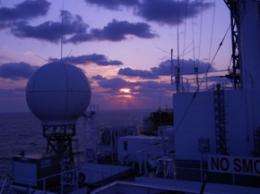
(Phys.org) -- For the past eight weeks, geoscience graduate student Tamara Jeppson has traded her usual commute, from her Madison apartment to Weeks Hall on the University of Wisconsin-Madison campus, for a single flight of stairs.
The stairs take her from her small cabin aboard the Japanese drilling vessel Chikyu to the laboratory where she spends her days analyzing geophysical data from the underwater fault zone responsible for the 2011 Tohoku earthquake and resulting tsunami.
Jeppson is one of 34 scientists in the Japan Trench Fast Drilling Project, which is drilling into the fault in search of clues to the conditions that led up to and ultimately triggered the 9.0 quake.
Studies in the initial months after the quake pointed to unusual fault behavior, including very large and rapid movement — between 30 and 60 meters of horizontal surface slip and five to 10 meters of vertical lift, all occurring in just a few minutes. That massive uprising — a larger amount of slip than scientists have previously been able to study — displaced huge volumes of seawater that ultimately resulted in the enormous tsunami.
The international team on the current expedition is looking at how geophysical properties change between the solid underground rock and the fault zone, to try to understand the conditions that led to the slip.
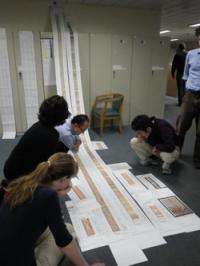
As a logging scientist and physical properties specialist, Jeppson has been analyzing data collected about the rock as they drill through it. Data about the strength, density, conductivity, and deformation of the rock can then be combined and correlated with information from the rock cores and other measurements to reconstruct a picture of the fault zone.
"We've made some inferences about where it is, how wide it is, what that could indicate for what we'd see in the rock and what happened when the earthquake occurred," Jeppson says.
The team has completed one borehole, in which they set a new record for scientific ocean drilling depth (7,740 meters below sea level), and are working on a second. They are now collecting core samples from the second hole to be able to analyze directly rocks from within the fault zone.
A remaining goal is to measure the temperature of the seafloor rocks as an indicator of the frictional stress at the fault zone. By getting to the fault relatively soon after the earthquake, Jeppson says, they hope to find lingering heat signatures from the plate movement. In the final days before the expedition ends on Friday, May 25, they will lower temperature sensors down within the last borehole to measure residual heat.
Work onboard goes on around the clock to maximize their time at sea and to offset the inevitable setbacks due to equipment failures and weather delays. Jeppson is assigned to the night shift, working midnight to noon, seven days a week. In her spare time, she's been keeping up with her classes as a first-year geoscience graduate student.
"My professors are e-mailing me the assignments that they're working on in class, and class members are emailing me their notes so I can work on them," she says.
Jeppson has also been documenting her experiences on a blog, "Searching for Namazu." Who is Namazu?
As she writes in her first entry, "According to Japanese mythology, Namazu is a giant catfish that lives in the mud beneath the islands of Japan. Namazu is restrained by the god Kashima, but when Kashima lets down his guard Namazu moves and the result is an earthquake."
For photos and more stories about living and working on the ship, visit Jeppson's blog or hear from other members of the scientific team here.
Provided by University of Wisconsin-Madison


