Swiss scientists demonstrate mind-controlled robot (Update)
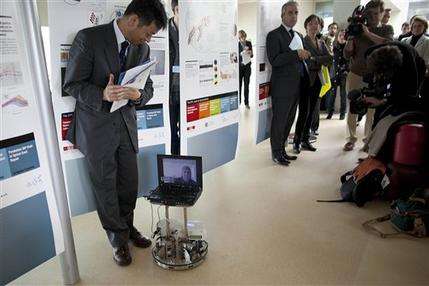
(AP) -- Swiss scientists have demonstrated how a partially paralyzed person can control a robot by thought alone, a step they hope will one day allow immobile people to interact with their surroundings through so-called avatars.
Similar experiments have taken place in the United States and Germany, but they involved either able-bodied patients or invasive brain implants.
On Tuesday, a team at Switzerland's Federal Institute of Technology in Lausanne used only a simple head cap to record the brain signals of Mark-Andre Duc, who was at a hospital in the southern Swiss town of Sion 100 kilometers (62 miles) away.
Duc's thoughts - or rather, the electrical signals emitted by his brain when he imagined lifting his paralyzed fingers - were decoded almost instantly by a laptop at the hospital. The resulting instructions - left or right - were then transmitted to a foot-tall robot scooting around the Lausanne lab.
Duc lost control of his legs and fingers in a fall and is now considered partially quadriplegic. He said controlling the robot wasn't hard on a good day.
"But when I'm in pain it becomes more difficult," he told The Associated Press through a video link screen on a second laptop attached to the robot.
Background noise caused by pain or even a wandering mind has emerged as a major challenge in the research of so-called brain-computer interfaces since they first began to be tested on humans more than a decade ago, said Jose Millan, who led the Swiss team.
While the human brain is perfectly capable of performing several tasks at once, a paralyzed person would have to focus the entire time they are directing the device.
"Sooner or later your attention will drop and this will degrade the signal," Millan said.
To get around this problem, his team decided to program the computer that decodes the signal so that it works in a similar way to the brain's subconscious. Once a command such as 'walk forward' has been sent, the computer will execute it until it receives a command to stop or the robot encounters an obstacle.
The robot itself is an advance on a previous project that let patients control an electric wheelchair. By using a robot complete with a camera and screen, users can extend their virtual presence to places that are arduous to reach with a wheelchair, such as an art gallery or a wedding abroad.
Rajesh Rao, an associate professor at the University of Washington, Seattle, who has tested similar systems with able-bodied subjects, said the Lausanne team's research appeared to mark an advance in the field.
"Especially if the system can be used by the paraplegic person outside the laboratory," he said in an email.
Millan said that although the device has already been tested at patients' homes, it isn't as easy to use as some commercially available gadgets that employ brain signals to control simple toys, such Mattel's popular MindFlex headset.
"But this will come in a matter of years," Millan said.
©2012 The Associated Press. All rights reserved. This material may not be published, broadcast, rewritten or redistributed.


