The Sun spits out a coronal mass ejection
Apr 17, 2012 By Nancy Atkinson
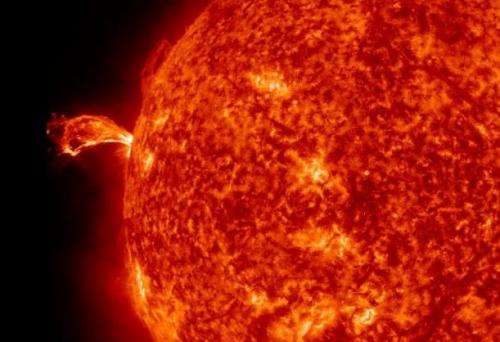
A CME from the Sun on April 15, 2012. Credit: Solar Dynamics Observatory

Ever squirted water out of your mouth when playing in a swimming pool or lake? This Coronal Mass Ejection (CME) release by the Sun on April 15, 2012 looks reminiscent of such water spouting.

But this burst of being hurled from the eastern limb of the Sun is more like an explosion, as such CMEs can release up to 100 billion kg (220 billion lb) of material, and the speed of the ejection can reach 1000 km/second (2 million mph) in some flares. Scientists at the Solar Dynamics Observatory say some of the explosions approach the power in one billion hydrogen bombs! In this video, the Sun hurled a cloud of plasma towards the STEREO B spacecraft and SDO captured the event in a couple of different wavelengths.

This video is not supported by your browser at this time.

Coronal Mass Ejections (CMEs) are balloon-shaped bursts of solar wind rising above the solar corona, expanding as they climb. Solar plasma is heated to tens of millions of degrees, and electrons, protons, and heavy nuclei are accelerated to near the speed of light. The super-heated electrons from CMEs move along the faster than the solar wind can flow. Rearrangement of the magnetic field, and may result in the formation of a shock that accelerates particles ahead of the CME loop.

This video is not supported by your browser at this time.
The prominence shot off the left side of the sun in association with an M1 class flare that was not Earth-directed. Credit: NASA/SDO/GSFC


Explore further: Nine-year-old Mars rover passes 40-year-old record

add to favorites email to friend print save as pdf

Related Stories

Scientists see solar outburst in exquisite detail

Apr 20, 2011

(PhysOrg.com) -- The largest disturbances to the Earth's geomagnetic environment occur when it is buffeted by solar material hurled in our direction by explosive changes in the Sun's atmosphere. These Coronal ...

Did a comet hit cause an explosion on the sun?

Oct 05, 2011

This amazing video from the SOHO mission (Solar and Heliospheric Observatory) shows a sun-diving comet hitting the solar surface on October 1, 2011 and unexpectedly a huge explosion occurs shortly after. Are the two events ...

Solar flares: What does it take to be X-class?

Aug 10, 2011

Solar flares are giant explosions on the sun that send energy, light and high speed particles into space. These flares are often associated with solar magnetic storms known as coronal mass ejections (CMEs). ...

Understanding coronal mass ejections

Oct 29, 2010

(PhysOrg.com) -- The corona of the sun is the hot (over a million kelvin), gaseous outer region of its atmosphere. The corona is threaded by intense magnetic fields that extend upwards from the surface in ...

Six coronal mass ejections in 24 hours

Sep 22, 2011

The sun let loose with at least six coronal mass ejections (CMEs) -- solar phenomena that can send solar particles into space and affect electronic systems in satellites -- from 7 PM ET on September 18, 2011 ...

NASA sees the sun having a solar blast (w/ video)

Jun 07, 2011

The Sun unleashed an M-2 (medium-sized) solar flare, an S1-class (minor) radiation storm and a spectacular coronal mass ejection (CME) on June 7, 2011 from sunspot complex 1226-1227. The large cloud of particles ...

Recommended for you

Mars rover Opportunity examines clay clues in rock

1 hour ago

(Phys.org) —NASA's senior Mars rover, Opportunity, is driving to a new study area after a dramatic finish to 20 months on "Cape York" with examination of a rock intensely altered by water.

NASA's STEREO detects a CME from the sun

14 hours ago

On 5:24 a.m. EDT on May 17, 2013, the sun erupted with an Earth-directed coronal mass ejection or CME, a solar phenomenon that can send billions of tons of solar particles into space that can reach Earth ...

Nine-year-old Mars rover passes 40-year-old record

22 hours ago

While Apollo 17 astronauts Eugene Cernan and Harrison Schmitt visited Earth's moon for three days in December 1972, they drove their mission's Lunar Roving Vehicle 19.3 nautical miles (22.210 statute miles ...

Bright explosion on the Moon

23 hours ago

For the past 8 years, NASA astronomers have been monitoring the Moon for signs of explosions caused by meteoroids hitting the lunar surface. "Lunar meteor showers" have turned out to be more common than anyone ...

User comments : 0

More news stories

Alaska volcano shoots ash 15,000 feet into the air

(AP)—One of Alaska's most restless volcanoes has shot an ash cloud 15,000 feet into the air in an ongoing eruption that has drawn attention from a nearby community but isn't expected to threaten air traffic.

Chinese, Indian airlines face EU pollution fines

Eight Chinese and two Indian airlines face fines of up to several million euros for not paying for their greenhouse gas emissions during flights within the bloc, the European Commission said on Friday.

Bright explosion on the Moon

For the past 8 years, NASA astronomers have been monitoring the Moon for signs of explosions caused by meteoroids hitting the lunar surface. "Lunar meteor showers" have turned out to be more common than anyone ...

US seizes Bitcoin operator accounts

US authorities seized the accounts of a Bitcoin digital currency exchange operator, claiming it was functioning as an "unlicensed money service business," court documents showed Friday.