Research on stickleback fish shows how adaptation to new environments involves many genes
Apr 03, 2012
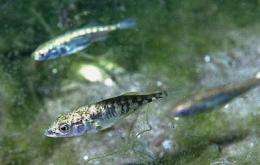
Gasterosteus aculeatus. Image: Wikipedia.

A current controversy raging in evolutionary biology is whether adaptation to new environments is the result of many genes, each of relatively small effect, or just a few genes of large effect. A new study published in Molecular Ecology strongly supports the first "many-small" hypothesis.

McGill University professor Andrew Hendry, from the Department of Biology and the Redpath Museum, and evolutionary geneticists at Basel University in Switzerland, studied how threespine stickleback fish adapted to lake and stream environments in British Columbia, Canada. The authors used cutting-edge genomic methods to test for genetic differences at thousands of positions ("loci") scattered across the stickleback genome. Very large genetic differences between lake and stream stickleback were discovered at more than a dozen of these loci, which is considerably more than expected under the alternative "few-large" hypothesis.

By examining four independently evolved lake-stream population pairs, the researchers were further able to show that increasing divergence between the populations involved that were larger and present at more and more loci.

As these results were obtained using new high-resolution , it is conceivable that previous perceptions of adaptation as being a genetically simple process are simply the result of a bias resulting from previous lower-resolution genomic methods.

"I suspect that as more and more studies use these methods, the tide of opinion will swerve strongly to the view that adaptation is a complex process that involves many genes spread across diverse places in the genome," says Prof. Hendry.

Explore further: Teaching complete evolutionary stories increases learning

More information: onlinelibrary.wiley.com/doi/10.1111/j.1365-294X.2012.05509.x/abstract

Related Stories

Large-scale analysis identifies 32 genetic loci for obesity

Oct 11, 2010

An international team of researchers has identified 18 new genetic loci associated with obesity assessed by BMI, and confirmed a link between obesity and 14 previously known loci. Almost 250,000 individuals were included ...

'Pelvis Has Left the Building'

Jun 04, 2009

(PhysOrg.com) -- New research shows that when two species of stickleback fish evolved and lost their pelvises and body armor, the changes were caused by different genes in each species. That surprised researchers, ...

Recommended for you

Surprise species at risk from climate change

2 hours ago

(Phys.org) —Most species at greatest risk from climate change are not currently conservation priorities, according to an International Union for Conservation of Nature (IUCN) study that has introduced a ...

User comments : 0

More news stories

Surprise species at risk from climate change

(Phys.org) —Most species at greatest risk from climate change are not currently conservation priorities, according to an International Union for Conservation of Nature (IUCN) study that has introduced a ...

Origins of 'The Hoff' crab revealed (w/ Video)

The history of a new type of crab, nicknamed 'The Hoff' because of its hairy chest, which lives around hydrothermal vents deep beneath the Southern Ocean and Indian Ocean, has been revealed for the first ...

EUROnu project recommends building Neutrino Factory

(Phys.org) —The European Union's Seventh Framework Programme, EUROnu, has submitted its findings to a panel at CERN. Charged with choosing a project to study the nature of matter and antimatter, the project ...

Antioxidant shows promise in Parkinson's disease

Diapocynin, a synthetic molecule derived from a naturally occurring compound (apocynin), has been found to protect neurobehavioral function in mice with Parkinson's Disease symptoms by preventing deficits in motor coordination.