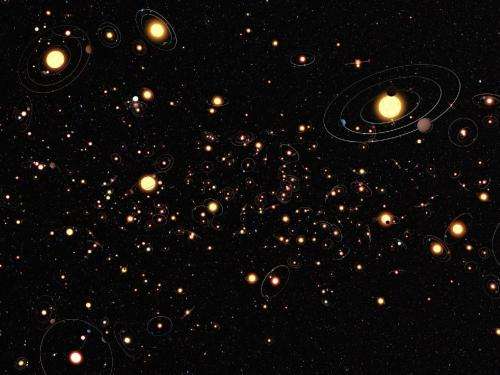
Image: The Milky Way's 100 billion planets
Apr 26, 2012
Image Credit: NASA, ESA, and M. Kornmesser (ESO)

(Phys.org) -- This artist's illustration gives an impression of how common planets are around the stars in the Milky Way. The planets, their orbits and their host stars are all vastly magnified compared to their real separations. A six-year search that surveyed millions of stars using the microlensing technique concluded that planets around stars are the rule rather than the exception. The average number of planets per star is greater than one. This means that there is likely to be a minimum of 1,500 planets within just 50 light-years of Earth.

The results are based on observations taken over six years by the PLANET (Probing Lensing Anomalies NETwork) collaboration, which was founded in 1995. The study concludes that there are far more Earth-sized planets than bloated Jupiter-sized worlds. This is based on calibrating a planetary mass function that shows the number of planets increases for lower mass worlds. A rough estimate from this survey would point to the existence of more than 10 billion across our galaxy.

The results were published in the Jan. 12, 2012, issue of the British science journal Nature.

Explore further: Unusual supernova is doubly unusual for being perfectly normal

add to favorites email to friend print save as pdf

Related Stories

Some stars capture rogue planets

Apr 17, 2012

(Phys.org) -- New research suggests that billions of stars in our galaxy have captured rogue planets that once roamed interstellar space. The nomad worlds, which were kicked out of the star systems in which ...

Recommended for you

Three centaurs follow Uranus through the solar system

Jun 18, 2013

Astrophysicists from the Complutense University of Madrid have confirmed that Crantor, a large asteroid with a diameter of 70 km has an orbit similar to that of Uranus and takes the same amount of time to ...

Final curtain for Europe's deep-space telescope

Jun 17, 2013

The deep-space telescope Herschel took its final bow on Monday, climaxing a successful four-year mission to observe the birth of stars and galaxies, the European Space Agency (ESA) said.

Hubble spots a very bright contortionist

Jun 17, 2013

(Phys.org) —The contorted object captured by Hubble in this picture is IRAS 22491-1808, also known as the South America Galaxy. It is an ultra-luminous infrared galaxy (ULIRG) that emits a huge amount of ...

Study explains decades of black hole observations

Jun 14, 2013

(Phys.org) —A new study by astronomers at NASA, Johns Hopkins University and Rochester Institute of Technology confirms long-held suspicions about how stellar-mass black holes produce their highest-energy ...

User comments : 1

Adjust slider to filter visible comments by rank

Display comments: newest first

rubberman
5 / 5 (2) Apr 26, 2012
I really hope I am still alive the day science finds a way to detect any kind of "life" signal out there.....

More news stories

Metamorphosis of moon's water ice explained

Using data gathered by NASA's Lunar Reconnaissance Orbiter (LRO) mission, scientists believe they have solved a mystery from one of the solar system's coldest regions—a permanently shadowed crater on the ...

Looking at sachet water consumption in Ghana

Many of West Africa's largest cities continue to lag in their provision of piped water to residents. Filling the service gap are plastic water sachets, which have become an important source of drinking water ...

LA to give every student an iPad; $30M order

Los Angeles' school system, the second largest in the United States, is ordering iPads for all its students, handing Apple a major success in its quest to make the tablet computer a replacement for textbooks.