Chechnya claims world's largest dinosaur eggs
Apr 17, 2012
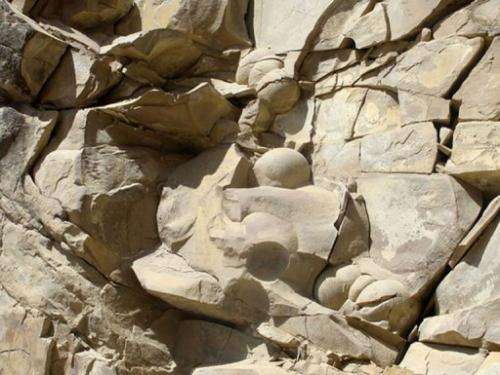
An undated handout picture released by Chechen State University shows the egg-shaped protrusions on a rock face in southern part of Chechnya. A university in Russia's Chechnya claimed today to have found an unprecedented stash of giant fossilised dinosaur eggs in a remote mountainous area of the North Caucasus region.

A university in Russia's Chechnya claimed on Tuesday to have found an unprecedented stash of giant fossilised dinosaur eggs in a remote mountainous area of the North Caucasus region.

The Chechen state university uploaded photos of the egg-shaped protrusions on a rock face discovered in the region's south on its website, calling them a "sensational find" and Russia's main channels showed the remote site Tuesday.

"The discovery is sensational not only for our republic, but because of the size of the eggs," some of which measure as long as 102 centimetres (40.16 inches), the university said. "There have never been such large (eggs) in the world."

Russian state television showed scientists scrambling about on a rocky mountainside chipping samples off the puzzling .

"Giant eggs set to lure tourists to Chechnya," the NTV channel headlined its story.

Chechnya has been trying to cast aside its reputation as a war-torn republic plagued by rampant corruption by hosting lavish sports and entertainment events and announcing plans for a large ski resort.

But a in Moscow questioned the authenticity of the reported discovery.

"Unfortunately, it's not true. Dinosaurs laid small eggs," said Valentina Nazarova of the Moscow State University's paleontology department, adding that dinosaurs probably never lived in the mountainous North Caucasus.

"Dinosaurs didn't lay eggs while jumping about like ," she said.

"If they want to create a legend for tourists, they should have said the were laid by a mythical Roc bird," she said, referring to a giant bird that features in the Arabian Nights tales.

"I am sincerely sorry for them, but I also wouldn't want to go against science."

Explore further: Shellfish show population growth did not send humans out of Africa

add to favorites email to friend print save as pdf

Related Stories

Ancient dinosaur nursery oldest nesting site yet found

Jan 23, 2012

An excavation at a site in South Africa has unearthed the 190-million-year-old dinosaur nesting site of the prosauropod dinosaur Massospondylus—revealing significant clues about the evolution of comple ...

Findings show ancient birds died in flash flood

Nov 14, 2011

(PhysOrg.com) -- During a presentation at the Society of Vertebrate Paleontology's 71st annual Meeting in Las Vegas, researchers Gareth Dyke and Darren Naish from the University of Southampton presented their findings of ...

Hundreds of dinosaur nests found in India

Oct 02, 2009

(PhysOrg.com) -- Geologists have discovered hundreds of fossilized nests each containing clutches of eight dinosaur eggs. The eggs were located in sand banks in Tamil Nadu in Southern India.

Recommended for you

Divers begin Lake Michigan search for Griffin ship

Jun 16, 2013

Divers began opening an underwater pit Saturday at a remote site in northern Lake Michigan that they say could be the resting place of the Griffin, a ship commanded by the 17th century French explorer La ...

Lost medieval city found in Cambodia

Jun 15, 2013

A lost medieval city that thrived on a mist-shrouded Cambodian mountain 1,200 years ago has been discovered by archaeologists using revolutionary airborne laser technology, a report said.

User comments : 0

More news stories

The hidden agenda of Obama's opposition

Is the US Tea Party movement a racial backlash against President Obama? A new study by Angie Maxwell from the University of Arkansas, and Wayne Parent from Louisiana State University, assesses whether racial attitudes are ...

Diabetes key to transplant success, research finds

(Medical Xpress)—Better management of diabetes could dramatically improve outcomes for lung transplant patients, with new research showing that those without diabetes lived twice as long as transplant recipients ...

Hybrid nanostructures: Getting to the core

Material scientists expect the new multifunctional properties of hybrid nanostructures will transform the development of high-performance devices, including batteries, high-sensitivity sensors and solar cells. ...