Nasa conducts new parachute test for Orion
Mar 02, 2012
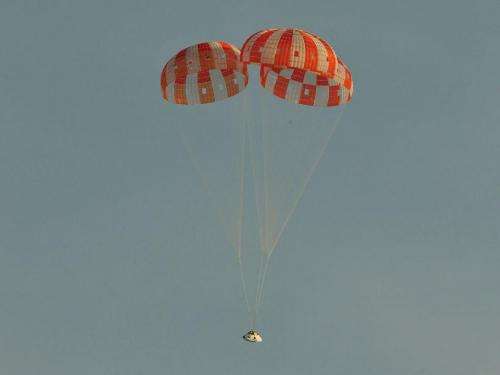
A test model of the Orion spacecraft with its parachutes was tested high above the skies over Arizona on Feb. 29. This particular drop test examined the wake - or the disturbance of the air flow behind Orion - that is caused by the spacecraft. This was the latest in a series of parachute drop tests conducted by NASA at the U.S. Army’s Proving Grounds in Yuma, Ariz. Photo credit: NASA

(PhysOrg.com) -- On Feb. 29, NASA successfully conducted another drop test of the Orion crew vehicle's entry, descent and landing parachutes high above the Arizona desert in preparation for the vehicle's orbital flight test in 2014. Orion will carry astronauts deeper into space than ever before, provide emergency abort capability, sustain the crew during space travel and ensure a safe re-entry and landing.

An Air Force C-17 plane dropped a test version of Orion from an altitude of 25,000 feet above the U.S. Army's Yuma Proving Grounds in Arizona. Orion's drogue chutes were deployed between 15,000 and 20,000 feet, followed by the pilot parachutes, which deployed the main landing parachutes. Orion landed on the desert floor at a speed of almost 17 mph, well below the maximum designed touchdown speed of the spacecraft.

The test examined how Orion's wake, the disturbance of the air flow behind the vehicle, would affect the performance of the . Parachutes perform optimally in smooth air that allows proper lift. A wake of choppy air can reduce parachute inflation. The test was the first to create a wake mimicking the full-size Orion vehicle and complete system.

Since 2007, the Orion program has conducted a vigorous parachute air and ground test program and provided the chutes for NASA’s successful pad abort test in 2010. All of the tests build an understanding of the chutes’ technical performance for eventual human-rated certification.

Explore further: Field tests in Mojave Desert pave way for human exploration of small bodies

add to favorites email to friend print save as pdf

Related Stories

NASA completes Orion spacecraft parachute testing in Arizona

Sep 23, 2011

NASA this week completed the first in a series of flight-like parachute tests for the agency's Orion spacecraft. The drop tests at the U.S. Army's Yuma Proving Grounds in Arizona support the design and development of the ...

Orion drop test on Jan. 06, 2012

Jan 09, 2012

(PhysOrg.com) -- After six months of testing, an 18,000 pound (8,165 kg) Orion mockup took its final splash into NASA Langley Research Center's Hydro Impact Basin on Jan. 6.

Testing Orion space capsule

Dec 14, 2011

(PhysOrg.com) -- Testing continues at NASA Langley Research Center as the 18,000-pound (8,165 kg) Orion test article took its eight and final splash of the year into the Hydro Impact Basin on Dec. 13. Orion, ...

NASA Successfully Tests Parachute for Ares Rocket

Mar 02, 2009

(PhysOrg.com) -- NASA and industry engineers successfully completed the second drop test of a drogue parachute for the Ares I rocket. The test took place Feb. 28 at the U.S. Army's Yuma Proving Ground near Yuma, Ariz.

Recommended for you

Mars rover Opportunity examines clay clues in rock

22 hours ago

(Phys.org) —NASA's senior Mars rover, Opportunity, is driving to a new study area after a dramatic finish to 20 months on "Cape York" with examination of a rock intensely altered by water.

NASA's STEREO detects a CME from the sun

May 17, 2013

On 5:24 a.m. EDT on May 17, 2013, the sun erupted with an Earth-directed coronal mass ejection or CME, a solar phenomenon that can send billions of tons of solar particles into space that can reach Earth ...

Nine-year-old Mars rover passes 40-year-old record

May 17, 2013

While Apollo 17 astronauts Eugene Cernan and Harrison Schmitt visited Earth's moon for three days in December 1972, they drove their mission's Lunar Roving Vehicle 19.3 nautical miles (22.210 statute miles ...

Bright explosion on the Moon

May 17, 2013

For the past 8 years, NASA astronomers have been monitoring the Moon for signs of explosions caused by meteoroids hitting the lunar surface. "Lunar meteor showers" have turned out to be more common than anyone ...

User comments : 0

More news stories

Galaxy's Ring of Fire

Johnny Cash may have preferred this galaxy's burning ring of fire to the one he sang about falling into in his popular song. The "starburst ring" seen at center in red and yellow hues is not the product of ...

Earth's center is out of sync

(Phys.org) —We all know that the Earth rotates beneath our feet, but new research from ANU has revealed that the center of the Earth is out of sync with the rest of the planet, frequently speeding up and ...