Male dolphins build complex teams for social success
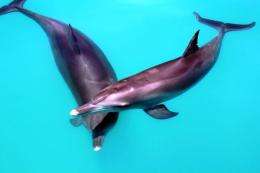
(PhysOrg.com) -- Male dolphins not only form a series of complex alliances based on their close relatives and friends but these alliances also form a shifting mosaic of overlapping geographic ranges within in an open social network, says a new study published in the journal Proceedings of the Royal Society B.
The study of bottlenose dolphins in Shark Bay, Western Australia, was led by Srdan Randic, a Master's student at the University of Massachusetts and supervised by Richard Connor, a Research Fellow at the UNSW Ecology and Evolution Research Centre. The team includes UNSW geneticist Dr Bill Sherwin and Michael Krutzen, a UNSW alumnus now at the University of Zurich.
Male dolphins use physical contact - petting and rubbing each other – to cement their personal bonds. Earlier studies had shown that the Shark Bay dolphins form three different kinds of alliances, but the study shows that they also enjoy a unique combination of “nested” male alliances within an open social network - a pattern not described before in comparable animals or dolphin communities.
Groups of two to three males form “first-order” alliances that involve close relatives, such as cousins, co-operating to guard or act as consorts to females. Long-running studies by many researchers at Shark Bay have revealed that these small groups may persist for up to 20 years.
“Sometimes one of these first-order alliances is seen to assist another to gain access to a female, but on another day the same two groups may be opposed in a contest over a female,” says Sherwin.
Teams of four to 14 males cooperate in “second-order” alliances to attack other alliances and to defend against such attacks. Second-order alliances can persist intact for over 15 years and may be considered the core unit of male social organization in Shark Bay, the researchers say.
Finally, two or more “second-order” groups may team up from time to time to form a “third-order” alliance. The study tackled the question of how they choose to make these alliances.
Randic’s team was able to exclude the so-called “community defence model” used by chimpanzees, for example, in which semi-closed communities (ones that occasionally accept new members emigrating from other groups) are defended by males ranging across their group’s entire range.
Nor do they follow the “mating season defence model”, where males defend a tighter geographic range only in the mating season. At such times, the range of one male alliance would have little overlap with others but would have considerable overlap with the range of certain female individuals, notes Sherwin.
But the study found that even the largest dolphin alliances do not do this. The key difference with comparable species seems to be that they have an open social network, with a fission–fusion grouping pattern with strongly differentiated relationships, including nested male alliances.
“We have now shown that males, like females, exhibit a continual mosaic of overlapping ranges,” says Connor. “Humans, elephants and other mammals live in semi-closed groups with sex-biased dispersal but have relationships with other groups. So humans and elephants differ from the dolphins in that key respect of living in semi-closed groups, but have in common a nested relationship structure.
“All three have unusually low costs of locomotion, which would have allowed larger ranges, leading to interactions with larger numbers of individuals and groups, further complicating their social lives.”
Provided by University of New South Wales


