Hubble views grand star-forming region
Mar 09, 2012
Credit: NASA, ESA, and F. Paresce (INAF-IASF, Bologna, Italy), R. O'Connell (University of Virginia, Charlottesville), and the Wide Field Camera 3 Science Oversight Committee

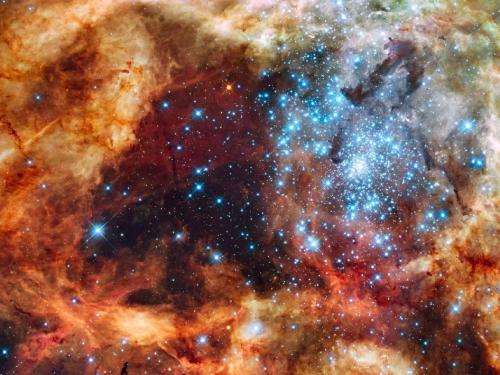
(PhysOrg.com) -- This massive, young stellar grouping, called R136, is only a few million years old and resides in the 30 Doradus Nebula, a turbulent star-birth region in the Large Magellanic Cloud, a satellite galaxy of the Milky Way. There is no known star-forming region in the Milky Way Galaxy as large or as prolific as 30 Doradus.

Many of the diamond-like icy blue stars are among the most massive stars known. Several of them are 100 times more massive than our sun. These hefty stars are destined to pop off, like a string of firecrackers, as supernovas in a few million years.

The image, taken in ultraviolet, visible and red light by Hubble's 3, spans about 100 light-years. The nebula is close enough to Earth that Hubble can resolve individual stars, giving astronomers important information about the stars' birth and evolution.

The brilliant stars are carving deep cavities in the surrounding material by unleashing a torrent of ultraviolet light, and hurricane-force stellar winds (streams of charged particles), which are etching away the enveloping cloud in which the stars were born. The image reveals a fantasy landscape of pillars, ridges, and valleys, as well as a dark region in the center that roughly looks like the outline of a holiday tree. Besides sculpting the gaseous terrain, the brilliant stars can also help create a successive generation of offspring. When the winds hit dense walls of gas, they create shocks, which may be generating a new wave of star birth.

These observations were taken Oct. 20-27, 2009. The blue color is light from the hottest, most massive stars; the green from the glow of oxygen; the red from fluorescing hydrogen.

Explore further: Researchers explain magnetic field misbehavior in solar flares

Related Stories

Celestial Season's Greetings from Hubble

Dec 19, 2006

Swirls of gas and dust reside in this ethereal-looking region of star formation imaged by NASA's Hubble Space Telescope. This majestic view, located in the Large Magellanic Cloud (LMC), reveals a region where ...

Drama in the heart of the Tarantula

Dec 11, 2008

Found in the nearby Large Magellanic Cloud, 30 Doradus is one of the largest massive star forming regions close to the Milky Way. Enormous stars in 30 Doradus, also known as the Tarantula Nebula, are producing ...

Before they were stars: New image shows space nursery

Jan 10, 2012

(PhysOrg.com) -- The stars we see today weren't always as serene as they appear, floating alone in the dark of night. Most stars, likely including our sun, grew up in cosmic turmoil — as illustrated in ...

A cosmic superbubble (w/ video)

Jul 20, 2011

(PhysOrg.com) -- ESO’s Very Large Telescope captured this striking view of the nebula around the star cluster NGC 1929 within the Large Magellanic Cloud, a satellite galaxy of our own Milky Way. A colossal ...

Recommended for you

Fragile mega-galaxy is missing link in history of cosmos

7 hours ago

Two hungry young galaxies that collided 11 billion years ago are rapidly forming a massive galaxy about 10 times the size of the Milky Way, according to UC Irvine-led research published Wednesday in the journal ...

Galaxy's Ring of Fire

May 18, 2013

Johnny Cash may have preferred this galaxy's burning ring of fire to the one he sang about falling into in his popular song. The "starburst ring" seen at center in red and yellow hues is not the product of ...

User comments : 1

Adjust slider to filter visible comments by rank

Display comments: newest first

Au-Pu
5 / 5 (1) Mar 09, 2012
An interesting but totally unscientific experience was when I first saw the movie "Space Odyssey". For the first time in my life I actually felt homesick. I had an overwhelming feeling that this was where I belong.
Years later when I see photographs like the one above and others of a similar nature I experience the same feeling.
I am not able to offer any logical reason for this, but I can assure you that the feelings are strong.
It is a very strong feeling of belonging there, as if it is my home, my origin, with an irrational wish to be there.

More news stories

Forecast for Titan: Wild weather could be ahead

(Phys.org) —Saturn's moon Titan might be in for some wild weather as it heads into its spring and summer, if two new models are correct. Scientists think that as the seasons change in Titan's northern hemisphere, ...

SDO observes mid-level solar flare

UPDATE 16:30 p.m. EDT: The M7-class flare was also associated with a coronal mass ejection or CME, another solar phenomenon that can send billions of tons of particles into space. While this CME was not Ea ...

NASA's Landsat satellite looks for a cloud-free view

For decades, Landsat satellites have documented the desiccation of the Aral Sea in Central Asia. Once one of the largest seas in the world, it shrunk to a tenth of its original volume after Russia diverted ...