March 30, 2012 report
Organic compounds found in proto-planetary disks
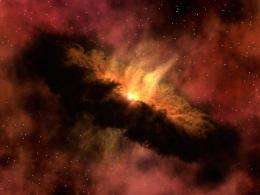
(PhysOrg.com) -- A new study from scientists in the US has reported that organic compounds could be formed in proto-planetary disks, and could have seeded the development of life in our own and other planetary systems.
Proto-planetary disks, such as that thought to have surrounded our Sun before the planets were formed, are rotating disks of gas and grains of dust, and are believed to be themselves to have been formed from dark molecular clouds. Scientists think the disks are the precursors of the planets and other planetary materials such as comets and asteroids, which form when the icy grains of dust within the disks coalesce together to form larger and larger chunks of rock.
Fred Ciesla of the University of Chicago and NASA astrophysicist Scott Sandford used computer modelling to test the hypothesis that organic compounds could be formed within the proto-planetary disk of our solar system, and need not be inherited from the clouds from which the disks formed. The model tracked the movement of thousands of individual ice-covered dust grains over a period of a million years. Most of the particles survived the period studied, and while some were captured by the Sun, many moved to outer areas above the plane of the disk, where they were exposed to high-energy photons of ultraviolet (UV) radiation, and warmer temperatures to evaporate the ice.
The computer model showed that conditions on the disks, including the levels of UV radiation, are similar to those in earlier laboratory experiments in which tiny, ice-covered grains of dust were exposed to UV radiation. The experiments showed that molecular bonds of compounds within the dust could be broken and the atoms could recombine to form complex organic molecules.
Organic compounds are the building blocks of life on Earth, and include amino acids and the nucleic bases that make up the DNA and RNA molecules.
In their paper in the journal Science, Ciesla, a planetary scientist, said the model for the proto-planetary disk in our solar system needed no special conditions, and the findings “fell out naturally,” which means similar findings are also likely in models of proto-planetary disks around other stars, since the dynamics, turbulence, and other features included in the model should be present in all such disks.
The processes by which any organic molecules formed on the proto-planetary disk could have ended up on Earth are still unclear, because in the early stages of Earth’s formation it would have been a molten mass in which any organic compounds present would have been destroyed. One theory is that the organic compounds were able to survive intact on comets and asteroids, where temperatures would not have been so high. Organic compounds such as amino acids, the building blocks of proteins, have also been found on meteorites hitting the Earth, which demonstrates that they can survive in space.
More information: Organic Synthesis via Irradiation and Warming of Ice Grains in the Solar Nebula, Science, DOI: 10.1126/science.1217291
ABSTRACT
Complex organic compounds, including many important to life on Earth, are commonly found in meteoritic and cometary samples, though their origins remain a mystery. We examined whether such molecules could be produced within the solar nebula by tracking the dynamical evolution of ice grains in the nebula and recording the environments they were exposed to. We found that icy grains originating in the outer disk, where temperatures were <30 K, experienced UV irradiation exposures and thermal warming similar to that which has been shown to produce complex organics in laboratory experiments. These results imply that organic compounds are natural byproducts of protoplanetary disk evolution and should be important ingredients in the formation of all planetary systems, including our own.
Journal information: Science
© 2012 PhysOrg.com


