Characterization of winter organic aerosols in Beijing, China
Organic aerosol (OA) is a crucial component of atmospheric fine particles. To achieve a better understanding of the sources of OA is very significant for air pollution control. In the 2012, Vol 57(7) of Chinese Science Bulletin, a paper identified three main sources of submicron OA in Beijing winter of 2010 with a high-resolution time-of-flight aerosol mass spectrometer. It provides a new effective strategy for moderating the fine particles pollution of Beijing.
Because submicron particulates (PM1) exhibit lengthy atmospheric residence time and are capable of deep pulmonary ingestion, the environmental and health impacts of PM1 are very significant. Organic aerosol is a large and important fraction of PM1 and has great impact on human health, especially because of some of the compounds have proved to be mutagens or carcinogens. Along with fast economical growth, the air quality in Beijing has suffered severe deterioration, with PM being one of the top pollutants. Organic matter is the most abundant fraction in fine particles in Beijing, accounting for 30-50% of the total mass, indicating its key role in air pollution control. Because the chemical compositions and sources of OA are complex (they can be classified as either primary OA (POA), from direct emissions, or secondary OA (SOA), from the oxidation of gas-phase precursors), the related studies on their chemical and physical characteristics have become difficult and a recent focus point. High time-resolution online measurements are needed to gain insight into aerosol chemical characteristics, sources and processes.
Professor Wang Yuesi and Dr. Liu Quan from State Key Laboratory of Atmospheric Boundary Layer Physics and Atmospheric Chemistry, Institute of Atmospheric Physics, Chinese Academy of Sciences performed the online observation of chemical compositions and size distributions of OA with a HR-ToF-AMS to reveal the variation regularity of organic aerosols in Bejing winter. Meanwhile, based on the data of the mass spectra of organic compounds, major sources of OA were resolved by positive matrix factorisation (PMF). Their work, entitled "In situ measurement of PM1 organic aerosol in Beijing winter using a high-resolution aerosol Mass Spectrometer", was published in Chinese Science Bulletin, 2012, Vol 57(7).
The mean OA mass concentration was 20.9±25.3 μg/m3 during this campaign, varying between 1.9 and 284.6 μg/m3. The average mass-based size distributions of OA present a prominent accumulation mode peaking at approximately 450 nm. During this study, the average H/C, O/C and N/C (molar ratio) were 1.70, 0.17, and 0.005, respectively, corresponding to an OM/OC ratio (mass ratio of organic matter to organic carbon) of 1.37. The diurnal pattern of O/C was consistent with that of OM/OC and displayed a typical photochemical characteristic.
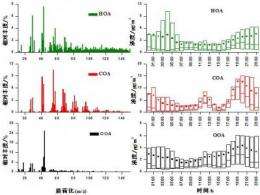
Positive Matrix Factorisation (PMF) analysis of the organic mass spectral dataset differentiated the OA into three components (Figure 1): hydrocarbon-like (HOA), cooking-related (COA), and oxygenated (OOA) organic aerosols, which, on average, accounted for 26.9%, 49.7% and 23.4%, respectively. The sum of HOA and COA could be regarded as POA, and the OOA corresponded to aged SOA. The POA is a dominant component of OA in Beijing winter, with a large percentage of 76.6%. The large contribution of COA in the POA mass indicates its key role in PM1 pollution control in Beijing.
More information: Liu Quan, Sun Yang, Hu Bo et al. In situ measurement of PM1 organic aerosol in Beijing winter using a high-resolution aerosol Mass Spectrometer. Chinese Science Bulletin, 2012, 57 (7): 819-826.
Journal information: Chinese Science Bulletin
Provided by Science in China Press


