A battle of the vampires, 20 million years ago?
Feb 02, 2012 By David Stauth
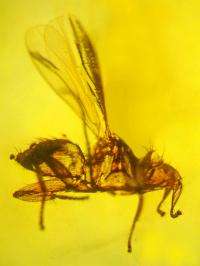
This is the only known fossil of a bat fly, a specimen at least 20 million years old that carried malaria and fed on the blood of bats. (Photo by George Poinar, Jr., courtesy of Oregon State University)

(PhysOrg.com) -- They are tiny, ugly, disease-carrying little blood-suckers that most people have never seen or heard of, but a new discovery in a one-of-a-kind fossil shows that “bat flies” have been doing their noxious business with bats for at least 20 million years.

For bats, that’s a long time to deal with a parasite doing its best vampire impression. Maybe it is nature’s revenge on the vampire bat, an aggressive blood consumer in its own right that will feed on anything from sheep to dogs and humans.

The find was made by researchers from Oregon State University in amber from the Dominican Republic that was formed 20-30 million years ago. The bat fly was entombed and perfectly preserved for all that time in what was then oozing tree sap and later became a semi-precious stone.

This is the only ever found of a bat fly, and scientists say it’s an extraordinary discovery. It was also carrying malaria, further evidence of the long time that malaria has been prevalent in the New World. The genus of bat fly discovered in this research is now extinct.

The findings have been published in two professional journals, Systematic Parasitology and Parasites and Vectors.

“Bat flies are a remarkable case of specific evolution, animals that have co-evolved with bats and are found nowhere else,” said George Poinar, Jr., an OSU professor of zoology and one of the world’s leading experts on the study of ancient ecosystems through plants and animals preserved in amber.

“Bats are mammals that go back about 50 million years, the only true flying mammal, and the earliest species had claws and climbed trees,” Poinar said. “We now know that bat flies have been parasitizing them for at least half that time, and they are found exclusively in their fur. They are somewhat flat-sided like a flea, allowing them to move more easily through bat fur.”

Not every bat is infested with bat flies, and some of the contemporary flies are specific to certain species of bats. But they are still pretty common and found around the world.

Bat flies only leave their bat in order to mate, Poinar said, and that’s probably what this specimen was doing when it got stuck in some sticky, oozing sap.

Explore further: Navy dolphins discover rare old torpedo off Calif. coast near Coronado

Related Stories

Some bat numbers up in Britain

Dec 31, 2006

At least four species of bats in Britain have reversed decades of declining populations and have grown in numbers recently.

Three new bat species discovered in Indochina

Sep 05, 2011

Three new bat species have been discovered after an international team of scientists from the Hungarian Natural History Museum (HNHM) and Fauna & Flora International (FFI) embarked on a study in southern Indochina.

Why does rain keep bats grounded?

May 05, 2011

(PhysOrg.com) -- In a new study published in Biology Letters, researcher Christian Voigt from the Leibniz Institute for Zoo and Wildlife Research in Germany details their findings on Sowell’s short-tailed bats a ...

Remarkable journeys may save bat species

Jul 12, 2007

Researchers have new hope for the future of an endangered species of bat after two of the flying mammals traveled 110 miles to a Welsh cave to live.

Hibernation keeps rabies going in bats

Jun 07, 2011

(PhysOrg.com) -- In a new study published in the Proceedings of the National Academy of Sciences, infectious disease biologist Dylan George from Colorado State University reports that a bat’s hibernation is wha ...

Recommended for you

Scientists take a new look at an ancient crop

10 hours ago

Though the price makes you wince, you might just buy that bottle of your favorite olive oil anyway. Perhaps it's exactly what you want for the salad dressing you're making tonight and for your special stir-fry ...

Bittersweet: Bait-averse cockroaches shudder at sugar

May 23, 2013

Sugar isn't always sweet to German cockroaches, especially to the ones that avoid roach baits. In a study published May 24 in the journal Science, North Carolina State University entomologists show the ne ...

White tiger mystery solved

May 23, 2013

White tigers today are only seen in zoos, but they belong in nature, say researchers reporting new evidence about what makes those tigers white. Their spectacular white coats are produced by a single change ...

User comments : 0

More news stories

EU bans three pesticides harmful to bees

The European Commission said Friday that it will ban for two years beginning in December pesticides blamed for killing the bees that pollinate food and fruit crops.

Galaxies fed by funnels of fuel

(Phys.org) —Computer simulations of galaxies growing over billions of years have revealed a likely scenario for how they feed: a cosmic version of swirly straws.

Google eyes emerging markets networks

Google has become deeply involved in a series of projects to build and operate wireless networks in emerging markets including sub-Saharan Africa and Southeast Asia, a report said Friday.