Scripps Research alumnus wins International Science and Engineering Visualization Challenge
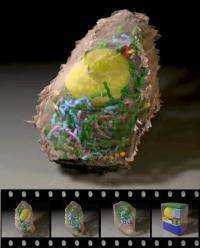
A powerful 3-D animation tool created by Graham Johnson oftthe Scripps Research Institute, Andrew Noske of the National Center for Microscopy & Imaging Research, and Bradley Marsh of the University of Queensland was selected as the winning video in the ninth annual International Science & Engineering Visualization Challenge. Original 3-D maps of pancreatic "beta" cells (top) precisely capture both the beauty and complexity of the molecular machinery within cells, while abstracted versions (bottom) employ simple geometric shapes to accurately depict the size, number, and length of various "compartments" or "organelles" within each cell. Photo courtesy of Graham Johnson
A powerful 3D animation tool created by Graham Johnson at The Scripps Research Institute has been selected as the winning video in the ninth annual International Science & Engineering Visualization Challenge.
The competition, co-sponsored by the National Science Foundation (NSF) and the journal Science, is designed to celebrate and encourage the visual communication of science for education and journalistic purposes. This year, 212 entries were received from 33 countries, representing every continent except Antarctica. For the first time this year, the public participated in the voting process, selecting their favorite images as People's Choice winners.
Johnson's entrythe result of a collaboration with Andrew Noske of the National Center for Microscopy & Imaging Research and Bradley Marsh of the Institute for Molecular Bioscience at the University of Queenslandwas selected as a first-place winner in the video category by both the judges and through People's Choice.
To create the winning entry, Johnson, Noske, and Marsh worked to create a prototype of Marsh's long-term goal of visually simplifying the complex 3D data sets collected in his lab through an imaging technique known as tomography.
Their winning video, "Rapid Visual Inventory & Comparison of Complex 3D Structures," illustrates the tool that enables scientists to compare and contrast multiple parameters of complicated structures, like those found in whole-cell tomograms, at a glance. The video shows how the tool can morph beta cells into simplified geometric versions to enable the visual comparison of the organelle volumes of a single cell and how it can compare relationships between four beta cells collected by Noske, Marsh, and colleagues under different physiological conditions.
"Scientists and general audiences alike can learn a great deal about biology by comparing the internal structural differences between cells harvested from different environments, say from different parts of your body or different lifecycle stages," said Johnson, an alumnus of the Scripps Research Institute's Kellogg School of Science and Technology and a newly appointed QB3@University of California San Francisco Faculty Fellow. "Morphing the cell from the complicated native model to the simplified version and back gets general audiences excited about the subject matter and reminds even expert audiences of the complex interplay of randomness and specific interaction that enables life to exist."
Johnson, Noske, and Marsh's video and other winning entries appear in the February 3 issue of Science.
This video is not supported by your browser at this time.
Provided by
The Scripps Research Institute
-
From lemons to lemonade: Reaction uses carbon dioxide to make carbon-based semiconductor,
33 comments
-
Thioridazine kills cancer stem cells in human while avoiding toxic side-effects of conventional cancer treatments,
3 comments
-
SpaceX private rocket blasts off for space station (Update),
42 comments
-
Landmark calculation clears the way to answering how matter is formed,
55 comments
-
Research team claims to have found evidence Lake Cheko is impact crater for Tunguska Event,
18 comments
-
Any Poe Fans Here?
May 22, 2012
-
Interesting WWII Public INformation Leaflet
May 19, 2012
-
Treaty of the Pyrenees
May 08, 2012
- More from Physics Forums - History & Humanities
More news stories
Change in developmental timing was crucial in the evolutionary shift from dinosaurs to birds: study
At first glance, it's hard to see how a common house sparrow and a Tyrannosaurus Rex might have anything in common. After all, one is a bird that weighs less than an ounce, and the other is a dinosaur that ...
Other Sciences / Archaeology & Fossils
12 hours ago |
5 / 5 (8) |
0
|
Social welfare cuts ultimately come with heavy price, researchers say
(Phys.org) -- Slashing government funding for Medicaid, food stamps and other programs that serve the poor while politically popular with some lawmakers and many conservatives may do more harm ...
Other Sciences / Social Sciences
May 24, 2012 |
4.1 / 5 (23) |
157
Ancient Bethlehem seal unearthed in Jerusalem
Israeli archaeologists have discovered a 2,700-year-old seal that bears the inscription "Bethlehem," the Israel Antiquities Authority announced Wednesday, in what experts believe to be the oldest artifact ...
Other Sciences / Archaeology & Fossils
May 23, 2012 |
3.3 / 5 (15) |
24
Dollars and sense: Why are some people morally against tax?
As the U.S. presidential election campaigns heat up, the economic debate is dominated by bailouts, austerity and, inevitably, taxation. Now a new study published in Symbolic Interaction asks why tax is such an important issue ...
Other Sciences / Social Sciences
May 23, 2012 |
2.3 / 5 (3) |
20
Oldest Jewish archaeological evidence on the Iberian Peninsula
German archaeologists of the Friedrich Schiller University Jena found one of the oldest archaeological evidence so far of Jewish Culture on the Iberian Peninsula at an excavation site in the south of Portugal, ...
Other Sciences / Archaeology & Fossils
May 25, 2012 |
4.2 / 5 (6) |
12
Stunning image of smallest possible five-ringed structure
Scientists have created and imaged the smallest possible five-ringed structure about 100,000 times thinner than a human hair and you'll probably recognise its shape.
'Unzipped' carbon nanotubes could help energize fuel cells, batteries
Multi-walled carbon nanotubes riddled with defects and impurities on the outside could replace some of the expensive platinum catalysts used in fuel cells and metal-air batteries, according to scientists at ...
Computer model used to pinpoint prime materials for efficient carbon capture
When power plants begin capturing their carbon emissions to reduce greenhouse gases and to most in the electric power industry, it's a question of when, not if it will be an expensive undertaking.
T cells 'hunt' parasites like animal predators seek prey, study shows
By pairing an intimate knowledge of immune-system function with a deep understanding of statistical physics, a cross-disciplinary team at the University of Pennsylvania has arrived at a surprising finding: T cells use a movement ...
Yale study concludes public apathy over climate change unrelated to science literacy
Are members of the public divided about climate change because they don't understand the science behind it? If Americans knew more basic science and were more proficient in technical reasoning, would public consensus match ...
Land and sea species differ in climate change response: study
(Phys.org) -- Marine and terrestrial species will likely differ in their responses to climate warming, new research by Simon Fraser University and Australia’s University of Tasmania has found.