Scientists call for protection of deep sea coral reefs from European fishing fleets
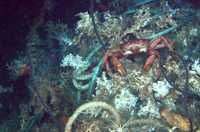
A team of scientists is calling for the urgent introduction of marine protected areas after producing evidence of long-term damage being done to deep-sea coral reefs by European fishing fleets.
Using underwater robotic vehicles, the researchers from Plymouth University recorded a diverse abundance of fish at several coral sites in the North East Atlantic but also signs that reefs are being smashed by modern fishing gear.
They documented more than 30 varieties of fish, including codling and northern cutthroat eels, at coral reef sites 300 km off the coast of Ireland. Diving down to depths of one kilometre, the vehicles took pictures of thousands of fish, and thriving ecosystems, dependent upon the reef.
The project, led by Dr. Jason Hall-Spencer of the School of Marine Sciences and Engineering, also found evidence of damage caused by rockhopper trawls that allow fishing nets to be dragged along the seabed even in rough seas. Images of abandoned fishing gear strewn over the sea-bed, which would have the potential to kill to wildlife, were also captured.
Dr. Hall-Spencer said: European coral reefs take thousands of years to form, and we now have ample evidence that bottom-trawling is causing long-term damage to fish habitat.
This highlights the need to introduce protected areas as soon as possible, where destructive types of fishing are outlawed.
The project was conducted under the EU KnowSeas project1. The footage of damage done by trawling, not to mention the evidence of abandoned fishing gear, will now be provided to a number of EU governments.
Dr. Marta Soffker, now a researcher at the University of Exeter, worked on the data for her Masters project. She said: This research provides further evidence of the importance of European coral reefs as they provide complex habitats that are home to a diverse range of fish.
We found patches that were densely populated by corals, crustaceans, and fish but also signs that trawls just plough through rich seabed habitats that can hardly be detected from the surface.
More information: The research is published in: In situ observations of fish associated with coral reefs off Ireland. Deep Sea Research Part I: Oceanographic Research Papers. 58(8): 818-825. Söffker, M. et al. (2011).
Provided by University of Plymouth
-
From lemons to lemonade: Reaction uses carbon dioxide to make carbon-based semiconductor,
33 comments
-
Thioridazine kills cancer stem cells in human while avoiding toxic side-effects of conventional cancer treatments,
3 comments
-
SpaceX private rocket blasts off for space station (Update),
42 comments
-
Landmark calculation clears the way to answering how matter is formed,
55 comments
-
Research team claims to have found evidence Lake Cheko is impact crater for Tunguska Event,
18 comments
-
Hypothetical desert earth
May 26, 2012
-
More human population = greater mass?
May 25, 2012
-
Conversion from aircraft bearing to normal degrees
May 23, 2012
-
Interpretation/Analysis of the Lab results(HEPA filter)
May 22, 2012
-
Has anyone here attended the The Urbino Summer School in Paleoclimatology?
May 22, 2012
-
Earthquakes: Mag 6 N. Italy and Mag 5.6 W. Bulgaria
May 21, 2012
- More from Physics Forums - Earth
More news stories
Yale study concludes public apathy over climate change unrelated to science literacy
Are members of the public divided about climate change because they don't understand the science behind it? If Americans knew more basic science and were more proficient in technical reasoning, would public consensus match ...
12 hours ago |
4.8 / 5 (6) |
29
|
Land and sea species differ in climate change response: study
(Phys.org) -- Marine and terrestrial species will likely differ in their responses to climate warming, new research by Simon Fraser University and Australia’s University of Tasmania has found.
10 hours ago |
4 / 5 (5) |
9
|
10 million years needed to recover from mass extinction
It took some 10 million years for Earth to recover from the greatest mass extinction of all time, latest research has revealed.
Space & Earth / Earth Sciences
12 hours ago |
4.2 / 5 (5) |
5
|
Sophisticated simulations predict future warming
The chances of our planet being hit by a global warming of 3 degrees Celsius by 2050 is as likely as it being hit by an increase of 1.4 degrees, new research shows. Presented in the journal Nature Geoscience, the British study ...
Space & Earth / Earth Sciences
May 22, 2012 |
3.8 / 5 (11) |
51
Kyoto Protocol architect 'frustrated' by climate dialogue
UN climate talks are going nowhere, as politicians dither or bicker while the pace of warming dangerously speeds up, one of the architects of the Kyoto Protocol told AFP.
May 23, 2012 |
3.4 / 5 (8) |
44
Stunning image of smallest possible five-ringed structure
Scientists have created and imaged the smallest possible five-ringed structure about 100,000 times thinner than a human hair and you'll probably recognise its shape.
'Unzipped' carbon nanotubes could help energize fuel cells, batteries
Multi-walled carbon nanotubes riddled with defects and impurities on the outside could replace some of the expensive platinum catalysts used in fuel cells and metal-air batteries, according to scientists at ...
Change in developmental timing was crucial in the evolutionary shift from dinosaurs to birds: study
At first glance, it's hard to see how a common house sparrow and a Tyrannosaurus Rex might have anything in common. After all, one is a bird that weighs less than an ounce, and the other is a dinosaur that ...
Computer model used to pinpoint prime materials for efficient carbon capture
When power plants begin capturing their carbon emissions to reduce greenhouse gases and to most in the electric power industry, it's a question of when, not if it will be an expensive undertaking.
T cells 'hunt' parasites like animal predators seek prey, study shows
By pairing an intimate knowledge of immune-system function with a deep understanding of statistical physics, a cross-disciplinary team at the University of Pennsylvania has arrived at a surprising finding: T cells use a movement ...
Browser wars flare in mobile space
The browser wars are heating up again, but this time the fight is for dominance of the mobile Internet.