Planck mission steps closer to the cosmic blueprint
Feb 13, 2012
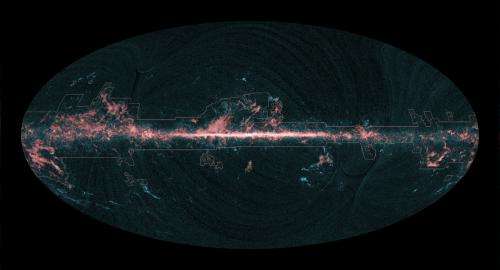
This all-sky image shows the distribution of carbon monoxide (CO), a molecule used by astronomers to trace molecular clouds across the sky, as seen by Planck (blue). A compilation of previous surveys (Dame et al. (2001)), which left large areas of the sky unobserved, has been superimposed for comparison (red). The outlines identify the portions of the sky covered by these surveys. Credits: ESA/Planck Collaboration; T. Dame et al., 2001

(PhysOrg.com) -- ESA's Planck mission has revealed that our Galaxy contains previously undiscovered islands of cold gas and a mysterious haze of microwaves. These results give scientists new treasure to mine and take them closer to revealing the blueprint of cosmic structure.

The new results are being presented this week at an international conference in Bologna, Italy, where from around the world are discussing the mission’s intermediate results.

These results include the first map of to cover the entire sky. Carbon monoxide is a constituent of the cold clouds that populate the Milky Way and other . Predominantly made of hydrogen molecules, these clouds provide the reservoirs from which stars are born.

However, hydrogen molecules are difficult to detect because they do not readily emit radiation. Carbon monoxide forms under similar conditions and, even though it is much rarer, it emits light more readily and therefore is more easily detectable. So, astronomers use it to trace the clouds of hydrogen.

“Planck turns out to be an excellent detector of carbon monoxide across the entire sky,” says Planck collaborator Jonathan Aumont from the Institut d’Astrophysique Spatiale, Universite Paris XI, Orsay, France.

Surveys of carbon monoxide undertaken with radio telescopes on the ground are extremely time consuming, hence they are limited to portions of the sky where molecular clouds are already known or expected to exist.

“The great advantage of Planck is that it scans the whole sky, allowing us to detect concentrations of molecular gas where we didn’t expect to find them,” says Dr Aumont.
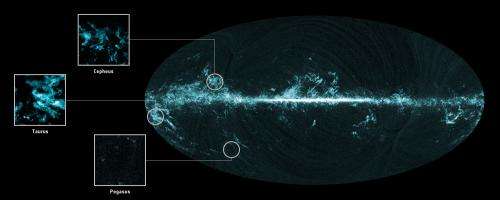
This all-sky image shows the distribution of carbon monoxide (CO), a molecule used by astronomers to trace molecular clouds across the sky, as seen by Planck. The inserts provide a zoomed-in view onto three individual regions on the sky where Planck has detected concentrations of CO: Cepheus, Taurus and Pegasus, respectively. Credits: ESA/Planck Collaboration

Planck has also detected a mysterious haze of that presently defies explanation.

It comes from the region surrounding the galactic centre and looks like a form of energy called synchrotron emission. This is produced when electrons pass through magnetic fields after having been accelerated by supernova explosions.

The curiosity is that the synchrotron emission associated with the galactic haze exhibits different characteristics from the synchrotron emission seen elsewhere in the Milky Way.

The galactic haze shows what astronomers call a ‘harder’ spectrum: its emission does not decline as rapidly with increasing energies.

Several explanations have been proposed for this unusual behaviour, including higher supernova rates, galactic winds and even the annihilation of dark-matter particles.

So far, none of them has been confirmed and it remains puzzling.

“The results achieved thus far by Planck on the galactic haze and on the carbon monoxide distribution provide us with a fresh view on some interesting processes taking place in our Galaxy,” says Jan Tauber, ESA’s Project Scientist for Planck.

Planck’s primary goal is to observe the Cosmic Microwave Background (CMB), the relic radiation from the Big Bang, and to measure its encoded information about the constituents of the Universe and the origin of cosmic structure.

But it can only be reached once all sources of foreground emission, such as the galactic haze and the carbon monoxide signals, have been identified and removed.

“The lengthy and delicate task of foreground removal provides us with prime datasets that are shedding new light on hot topics in galactic and extragalactic astronomy alike,” says Dr Tauber.

“We look forward to characterising all foregrounds and then being able to reveal the CMB in unprecedented detail.”

Planck’s first cosmological dataset is expected to be released in 2013.

Explore further: Unusual supernova is doubly unusual for being perfectly normal

Related Stories

Planck unveils wonders of the Universe (w/ Video)

Jan 11, 2011

(PhysOrg.com) -- The first scientific results from ESA’s Planck mission were released at a press briefing today in Paris. The findings focus on the coldest objects in the Universe, from within our Galaxy ...

Planck instruments ready for integration

Nov 16, 2006

Engineers are ready to begin integrating the scientific instruments into ESA's Planck satellite. The pair of instruments will allow the spacecraft to make the most precise map yet of the relic radiation left ...

Planck sees tapestry of cold dust (w/ Video)

Mar 17, 2010

(PhysOrg.com) -- Giant filaments of cold dust stretching through our Galaxy are revealed in a new image from ESA's Planck satellite. Analysing these structures could help to determine the forces that shape ...

Recommended for you

Three centaurs follow Uranus through the solar system

Jun 18, 2013

Astrophysicists from the Complutense University of Madrid have confirmed that Crantor, a large asteroid with a diameter of 70 km has an orbit similar to that of Uranus and takes the same amount of time to ...

Final curtain for Europe's deep-space telescope

Jun 17, 2013

The deep-space telescope Herschel took its final bow on Monday, climaxing a successful four-year mission to observe the birth of stars and galaxies, the European Space Agency (ESA) said.

Hubble spots a very bright contortionist

Jun 17, 2013

(Phys.org) —The contorted object captured by Hubble in this picture is IRAS 22491-1808, also known as the South America Galaxy. It is an ultra-luminous infrared galaxy (ULIRG) that emits a huge amount of ...

Study explains decades of black hole observations

Jun 14, 2013

(Phys.org) —A new study by astronomers at NASA, Johns Hopkins University and Rochester Institute of Technology confirms long-held suspicions about how stellar-mass black holes produce their highest-energy ...

User comments : 5

Adjust slider to filter visible comments by rank

Display comments: newest first

baudrunner
not rated yet Feb 13, 2012
Synchrotron emission occurs when electrons are forced to turn a corner, ie. divert from their common trajectory, which might be a straight line for measurement purposes.
Tuxford
1 / 5 (4) Feb 13, 2012
I am afraid that high energy synchrotron radiation from the galactic core is a key feature of LaViolette's superwave theory. Sorry guys.
jsdarkdestruction
not rated yet Feb 14, 2012
planck keeps on revealing the secrets of our universe, its awesome. thanks planck!
rah
1 / 5 (3) Feb 14, 2012
The fact that this mission is an ESA mission and not primarily a NASA/US mission should be noted as the beginning of the peaking and decline of the United States. It stems from 60 years of failing to use the television as the best educational device ever invented, (until the internet came along), and in fact allowing 3 generations of Americans to use the TV as an brain-deadening anesthetic. Now the internet is turning into the next generation of the TV. Congratulations to the Planck Team!
mharratsc
1 / 5 (3) Feb 14, 2012
Rather, synchrotron radiation is emitted from charged particles curving through a magnetic magnetic field, typically seen in spiraling jets, field-aligned currents, Bennett pinches, and plasmoids.

Speaking of which, this sure seems indicative that the center of the galaxy is a plasmoid rather than a fictitious singularity.

More news stories

Metamorphosis of moon's water ice explained

Using data gathered by NASA's Lunar Reconnaissance Orbiter (LRO) mission, scientists believe they have solved a mystery from one of the solar system's coldest regions—a permanently shadowed crater on the ...

Looking at sachet water consumption in Ghana

Many of West Africa's largest cities continue to lag in their provision of piped water to residents. Filling the service gap are plastic water sachets, which have become an important source of drinking water ...