NTT researchers develop breakthrough optical memory device
February 27, 2012 by Bob Yirka report

NTT researchers develop breakthrough optical memory device

Enlarge

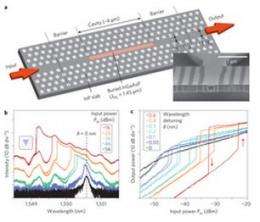
Device structure and static response. Image: Nature Photonics (2012) doi:10.1038/nphoton.2012.2

(PhysOrg.com) -- To improve transmission speeds, the Internet has transitioned over the years from one using copper to fiber optic cabling. Unfortunately, this has caused a bottleneck to occur where the light signals meet with electronic circuitry. Researchers have been working for years on a way to make routers, and most particularly, their memory, all optic, to avoid having to convert the signals at all. Now, it appears one such group, NTT, a Japanese telecommunications company, has figured out a way to do it. They describe their work in a paper published in Nature Photonics.

All computer memory is based on a material that is able to have 1s and Os written on to it and held in such a state long enough to be useful. Also necessary is an ability to erase or write over those 1s and Os so that the same memory material can be used over and over.

The new memory device created by the NTT team relies on that are created in a material that can be made to represent 1s and Os by either transmitting light, or by blocking it.

To make the memory cell, the team buried a very tiny strip of indium phosphide in a small piece of . The outer portion was then etched with holes small enough to control the flow of laser light of a certain frequency. They left a path running though the middle of the material un-etched to provide a means for light from a laser to move in and out of the cell.

When laser light is shone on the material, it follows the path through the memory cell and the is changed causing a pulse of light to either pass through on not, representing either a 1 or O state. Another pulse changes it to another state and so on. To help the memory material maintain its state, a second laser provides a constant stream of background light.

The memory cell was able to hold onto the state it created for a microsecond, which quadruples the old record and it also uses far less energy than conventional designs. A memory chip with four of the optical memory cells consumes just 30 millawatts of energy, whereas common use flash drives use five times that amount.

But the real breakthrough here is the development of actual memory cells based on optics that are able to hold onto the data states they create long enough for them to be used by other parts of a hardware device. And while the memory cells are far too large to be of use right now, new designs based on this work might just lead to that elusive Holy Grail, an Internet backbone made entirely of optical components.

More information: Ultralow-power all-optical RAM based on nanocavities, Nature Photonics (2012) doi:10.1038/nphoton.2012.2

Abstract
Optical random-access memory (o-RAM) has been regarded as one of the most difficult challenges in terms of replacing its various functionalities in electronic circuitry with their photonic counterparts. Nevertheless, it constitutes a key device in optical routing and processing. Here, we demonstrate that photonic crystal nanocavities with an ultrasmall buried heterostructure design can solve most of the problems encountered in previous o-RAMs. By taking advantage of the strong confinement of photons and carriers and allowing heat to escape efficiently, we have realized all-optical RAMs with a power consumption of only 30 nW, which is more than 300 times lower than the previous record, and have achieved continuous operation. We have also demonstrated their feasibility in multibit integration. This paves the way for constructing a low-power large-scale o-RAM system that can handle high-bit-rate optical signals.

Journal reference: Nature Photonics search and more info website

© 2011 PhysOrg.com

4.7 /5 (11 votes)  

Filter


Move the slider to adjust rank threshold, so that you can hide some of the comments.


Display comments: newest first

Vendicar_Decarian
Feb 27, 2012

Rank: not rated yet
Nope.

1: No such unit exists.

2: Presuming the most obvious misspelling a non-obvious comparison is being made between 4 bits (optical), and 64 billion bits (silicon)

"A memory chip with four of the optical memory cells consumes just 30 millawatts of energy, whereas common use flash drives use five times that amount." - article
Rank 4.7 /5 (11 votes)
Relevant PhysicsForums posts

More news stories

Landmark calculation clears the way to answering how matter is formed

(Phys.org) -- An international collaboration of scientists, including Thomas Blum, associate professor of physics, is reporting in landmark detail the decay process of a subatomic particle called a kaon – ...

Physics / General Physics

created May 25, 2012 | popularity 4.3 / 5 (24) | comments 55 | with audio podcast

Is a classical electrodynamics law incompatible with special relativity?

(Phys.org) -- The laws of classical electromagnetism that were developed in the 19th century are the same laws that scientists use today. They include Maxwell’s four equations along with the Lorentz la ...

Physics / General Physics

created May 24, 2012 | popularity 4.7 / 5 (18) | comments 43 | with audio podcast feature

Lying in wait for WIMPs: Researchers seek to dramatically increase sensitivity of Large Underground Xenon detector

Although it's invisible, dark matter accounts for at least 80 percent of the matter in the universe. No one knows what it is, but most scientists would bet on weakly interacting massive particles, or WIMPs.

Physics / General Physics

created May 23, 2012 | popularity 4 / 5 (7) | comments 19 | with audio podcast

Hawaii lab turns laser-powered bubbles into microrobots

(Phys.org) -- A team of scientists from the University of Hawaii are working on microrobots created from bubbles of air in a saline solution. The bubbles take on their title of “robots” as a laser ...

Physics / General Physics

created May 23, 2012 | popularity 5 / 5 (4) | comments 2 | with audio podcast weblog

Sound increases the efficiency of boiling

Scientists at the Georgia Institute of Technology achieved a 17-percent increase in boiling efficiency by using an acoustic field to enhance heat transfer. The acoustic field does this by efficiently removing vapor bubbles ...

Physics / Soft Matter

created May 24, 2012 | popularity 5 / 5 (2) | comments 2


Stunning image of smallest possible five-ringed structure

Scientists have created and imaged the smallest possible five-ringed structure – about 100,000 times thinner than a human hair – and you'll probably recognise its shape.

'Unzipped' carbon nanotubes could help energize fuel cells, batteries

Multi-walled carbon nanotubes riddled with defects and impurities on the outside could replace some of the expensive platinum catalysts used in fuel cells and metal-air batteries, according to scientists at ...

Change in developmental timing was crucial in the evolutionary shift from dinosaurs to birds: study

At first glance, it's hard to see how a common house sparrow and a Tyrannosaurus Rex might have anything in common. After all, one is a bird that weighs less than an ounce, and the other is a dinosaur that ...

Computer model used to pinpoint prime materials for efficient carbon capture

When power plants begin capturing their carbon emissions to reduce greenhouse gases – and to most in the electric power industry, it's a question of when, not if – it will be an expensive undertaking.

T cells 'hunt' parasites like animal predators seek prey, study shows

By pairing an intimate knowledge of immune-system function with a deep understanding of statistical physics, a cross-disciplinary team at the University of Pennsylvania has arrived at a surprising finding: T cells use a movement ...

Yale study concludes public apathy over climate change unrelated to science literacy

Are members of the public divided about climate change because they don't understand the science behind it? If Americans knew more basic science and were more proficient in technical reasoning, would public consensus match ...