Nanoparticles may enhance cancer therapy
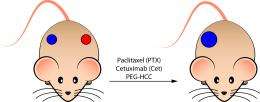
A mixture of current drugs and carbon nanoparticles shows potential to enhance treatment for head-and-neck cancers, especially when combined with radiation therapy, according to new research by Rice University and the University of Texas MD Anderson Cancer Center.
The work blazes a path for further research into therapy customized to the needs of individual patients. The therapy uses carbon nanoparticles to encapsulate chemotherapeutic drugs and sequester them until they are delivered to the cancer cells they are meant to kill.
A paper on the research was published this month in the American Chemical Society journal ACS Nano.
The new strategy by Rice chemist James Tour and Jeffrey Myers, a professor of head-and-neck surgery at MD Anderson, combines paclitaxel (PTX) and Cetuximab (Cet) with hydrophilic carbon clusters functionalized with polyethylene glycol, known as PEG-HCC.
Cetuximab, the targeting agent, is a humanized monoclonal antibody that binds exclusively to the epidermal growth factor receptor (EGFR), a cell-surface receptor overexpressed by 90 percent of head-and-neck squamous cell cancers. Paclitaxel, an active agent in chemotherapy, is used to treat lung, ovarian, breast and head-and-neck cancers. In combination, they have the ability to target and attack cancerous cells.
Because paclitaxel is hydrophobic – it won't mix with water – the substances are generally combined with Cremophor EL, a castor oil-based carrier that allows the compound marketed as Taxol to be delivered intravenously to patients.
Tour, Myers and their associates have found a simple way to mix PTX and Cetuximab with carbon clusters that adsorb the active ingredients. The new compound is water-soluble and is more effective at targeting tumors than Taxol while avoiding the toxic effects of paclitaxel and Cremophor on adjacent healthy cells, they wrote.
"It's very common to administer cortical steroids to limit the allergic response to Cremophor EL," said Tour, Rice's T.T. and W.F. Chao Chair in Chemistry as well as a professor of mechanical engineering and materials science and of computer science.
Tour said the Cet/PTX/PEG-HCC elements combine easily. "We show in the paper that when we take paclitaxel up in our hydrophilic carbon clusters, we can deliver these just as well as commercial Taxol.
"But you can never break into a market with something that's just as good as what's already out there. You have to be substantially better. The beauty of what we're doing is that we can potentially use a much smaller amount of the drug for chemotherapy. Just eliminating the Cremophor is a real advantage," he said.
Tour noted a recently approved chemotherapy drug that combines paclitaxel with albumin nanoparticles, Abraxane, also shows promise. "That works well, but it still only has about 10 percent of the market after six or seven years of use," he said.
Myers, the Hubert L. and Olive Stringer Distinguished Professor in Cancer Research at MD Anderson, said combining Cet/PTX/PEG-HCC and radiation therapy in tests on mice showed a significant boost in killing tumors. "Our hypothesis is that PTX, the chemotherapy drug, sensitizes the cancer cells to the effects of radiation and the Cetuximab/PEG-HCC increases the delivery of PTX to the cancer cells," he said.
Unlike Cremophor, Tour said, the enhanced carbon clusters are nontoxic. Biodistribution and toxicity studies showed the "large majority" of PEG-HCCs are excreted through the kidneys, while trace amounts in the livers and spleens of mice tested showed no damage to the organs.
The strategy sprang from conversations between Tour and Rice chemist and Nobel laureate Richard Smalley, who died of leukemia in 2005. "I was sitting with Rick at MD Anderson while he was being treated, and we got to talking about using carbon particles for delivery as carbon-based carriers.
"But we had nothing specific," Tour said. "I started to work on this without funding, and shortly after Rick's passing in October 2005, I met with Jeff Myers."
"I wanted to establish a multidisciplinary program to study nanoparticle-based therapeutics for cancer in general, and more specifically, head-and-neck cancer," Myers said. "At the time, Dr. Garth Powis (professor and chair of the Department of Experimental Therapeutics at MD Anderson) directed me to Dr. Mauro Ferrari (now president of The Methodist Hospital Research Institute and an adjunct professor of bioengineering at Rice), who ultimately put me in touch with Dr. Tour.
"His enthusiasm for science and willingness to further explore the potential of carbon nanoparticles to treat cancer patients was apparent right away, and we launched a collaborative effort that has been quite productive," he said.
Myers is pleased with what the team has accomplished so far. "This collaborative work has 'proved the principle' that carbon nanoparticles can be used to non-covalently link a chemotherapeutic drug with a targeting antibody that can deliver the drug specifically to a cancer cell," he said. "This principle could be used to deliver other drugs to other types of cells through specific targeting of cell surface receptors as a method of increasing the therapeutic ratio.
"Though I am not an expert in these other areas, this could potentially have applications in infectious diseases, neurologic disorders and cardiovascular illnesses," he said.
Tour sees potential for clinical uses of PEG-HCCs for brain cancer and traumatic brain injuries as well as chemotherapy, but acknowledged the introduction of such drugs for human use is a long way off. "To get a drug through all the different phases, including trials, typically takes 12 to 14 years and about $1.25 billion," he said. "That can sometimes be expedited through experimental trials with patients who have no other options, but it's still a long and expensive haul."
Still, he said the new work is a strong step in the right direction. "This paper is the highlight of six years of research," he said. "It all came together. This is the crescendo, right here."
More information: Read the abstract at pubs.acs.org/doi/abs/10.1021/nn204885f
Provided by Rice University


