Jurassic salamanders with stomach contents found from Inner Mongolia
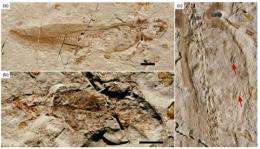
Paleontologists from Chinese Academy of Sciences reported two Jurassic salamanders with stomach contents from Daohugou, Ningcheng County, Inner Mongolia, China, as reported in Chinese Science Bulletin online January 2012 (Vol.57, No.1). This is the first report of well-established fossil caudates with food in their stomachs, and these specimens provide important evidence supporting hypotheses about ecological interactions in the Jurassic ecosystem of Daohugou.
The Jurassic site at Daohugou, Ningcheng County, Inner Mongolia, China, has yielded an important assemblage of fossil plants, invertebrates (e.g. anostracans, conchostracans, spiders, harvestmen, and insects), and vertebrates (e.g. salamanders, lizards, feathered dinosaurs, pterosaurs, and mammals). The caudates from this locality are dominanted by neotenic species, Jeholotriton paradoxus, and Chunerpeton tianyiensis, as well as the metamorphosed Liaoxitriton daohugouensis, and many of them are well-preserved articulated skeletons, even retaining soft tissue impressions (e.g. eyes, gills, skin, tail fins). Among more than 600 caudate specimens recovered, two specimens of Jeholotriton paradoxus (IVPP V14195, IVPP V18083) with conchostracans preserved in stomachs and nine specimens of Chunerpeton tianyiensis (IVPP V18084–V18092) with corixids preserved in stomachs have been recognized.
Researchers observed there are more than 50 conchostracan carapaces in the abdominal region of juvenile Jeholotriton paradoxus (IVPP V14195), which is about 96 mm in length (from the snout to the tip of the tail). The carapace valves identified as stomach contents are clustered, overlapping heavily, and the margin of the conchostracan cluster below the vertebral column within the outline of the abdominal region. The carapaces are relatively small, whereas the conchostracans from Daohugou bed are normally dispersed and have a large size range. This suggests selection of prey size by the predator. The conchostracans in the abdominal area appear relatively circular, in contrast to the more or less oval carapace valves outside the salamander’s body. Their rounded shape could be a result of softening of the chitinous valves during digestion. A proportionally large number of the conchostracans in the abdominal region are preserved dorsally with the two valves open, suggesting the adductor muscle had been digested before burial. No tooth marks are present on the surfaces of the conchostracan valves in the abdomen, implying that they must have been swallowed whole rather than bitten. The conchostracans in the abdominal region appear to occupy nearly the entire body cavity, probably because the carapaces broke the gut and entered the coelom as they were pressed during burial. All the conchostracans on the slabs can be identified to be a single species Euestheria luanpingensis.
“It is not surprising to discover that a Jurassic salamander ate conchostracans. Werneburg described a specimen of the temnospondyl Apateon with a skull length of 10 mm, whose stomach contents included small conchostracans. Apateon is probably close to the ancestral salamander condition. Extant caudates (e.g. Ambystoma cingulatum; Salamandra salamandra) have also been reported as preying on conchostracans”, said the first study author DONG Liping, a paleontologist graduate student of Institute of Vertebrate Paleontology and Paleoanthropology (IVPP).
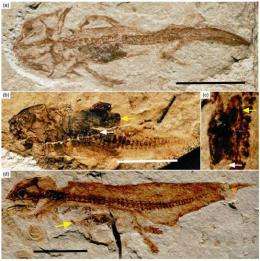
Nine specimens with stomach contents can be referred to juvenile Chunerpeton tianyiensis, ranging from 30 to 62 mm in length (from the snout to the tip of the tail), and the contained corixid Yanliaocorixa chinensis, is a common insect of the Yanliao entomofauna. The corixids found in the stomachs of these salamanders are 5–6 mm in length, and exclusively represent adults or last larval instars, suggesting size-based selective feeding of the live predator. The head or fore wings of these corixids are sometimes disarticulated, indicating that the joints was digested in the stomach. In addition, there are no tooth marks on the eaten corixids, indicating that they were probably swallowed whole.
“Chunerpeton could eat more than one individual corixid in a meal, as shown in Figure 2(b), and sometimes took many more as indicated by IVPP V18089, in which as many as five corixids can be observed in the abdominal region”, said the study coauthor HUANG Diying, Nanjing Institute of Geology and Palaeontology.
“Living newts tend to change their diet as they grow. Younger juveniles generally feed on very small prey, such as protozoans and vegetation fragments. As growth proceeds, they begin to forage on moderately sized invertebrates, such as corixids and minute crustaceans, and then switch to even larger prey that may include small juvenile conspecies. As described above, juvenile Jeholotriton preyed on only small conchostracans about 2 mm long, and juvenile Chunerpeton ate only adult corixids 5–6 mm long. The adults of each salamander taxon presumably took larger prey, such as fishes or frogs, as do their living relatives. However, no adult specimens of Jeholotriton or Chunerpeton have been found with stomach contents preserved, so the adult diet of these taxa remains uncertain”, said Dr. WANG Yuan, coauthor of the study and professor of the IVPP, “Jurassic caudates with gut contents can also provide insights into the feeding behaviors and foraging environments of these ancient, tailed amphibians.”
This work was supported by the National Natural Science Foundation of China and the Knowledge Innovation Program of the Chinese Academy of Sciences.
Journal information: Chinese Science Bulletin
Provided by Institute of Vertebrae Paleontology and Paleoanthropology


